liveBook · Manning

Bayesian optimization

As explained in Designing Deep Learning Systems: A guide for software engineers

Bayesian optimization is a sequential optimization technique that uses a probabilistic surrogate model to select promising evaluations of an expensive objective.

Bayesian optimization is a sequential optimization technique for expensive objectives. In hyperparameter optimization (HPO), it is one of three major algorithm families, alongside model-free and multifidelity optimization. Its role is to guide trial selection rather than treat every candidate configuration equally. section 5.2.2

Use it as one selectable strategy within an HPO system, not as a universally best default. Algorithm choice depends on the HPO task and its constraints; the practical objective is to find hyperparameters that minimize a predefined loss for a training workload. section 5.2.2 section 5.5
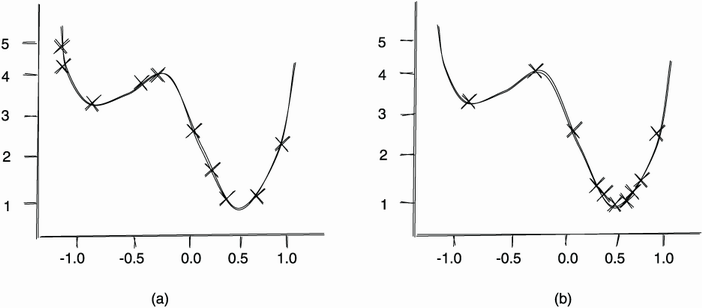
Figure 5.5 A data sampler comparison of random search (a) and Bayesian approach (b) using 10 trials

Compare how a Bayesian approach samples trials against random search when both are limited to 10 trials. section 5.2.2

For production HPO, pair algorithm selection with execution infrastructure: trials can be parallelized, distributed training can be introduced, and unpromising trials can be stopped early. Larger teams may use an HPO service for automated black-box operation and resource management. section 5.5


How Designing Deep Learning Systems: A guide for software engineers covers it

How deep it goes
Introduces Bayesian optimization at a high level for building or setting up an HPO system, deferring mathematical reasoning.
Examples
Compares Bayesian and random-search data sampling across 10 trials.
What it assumes
Teaches the algorithm family from high-level HPO engineering context without requiring mathematical reasoning.
What you can do after
Operate/configure it as an HPO algorithm choice under task and infrastructure constraints.
How it connects
Connects Bayesian optimization with hyperparameter optimization, model-free optimization, multifidelity optimization, random search, and HPO services.

Also explained in

Compare how 5 books explain Bayesian optimization →

Related concepts

This explainer was generated by Manning's knowledge graph from the text of Designing Deep Learning Systems: A guide for software engineers. The section links point to the parts of the book it draws on.


