Surrogate model
A surrogate model is an approximate model that estimates the behavior or outputs of a more complex, costly, or otherwise unavailable model, process, or function.

Experimentation for Engineers
A surrogate function is a model that approximates a measured response as a function of parameter values and estimates the response at unmeasured values.
- How it is used
- Accelerates response-surface optimization by estimating business metrics at unmeasured parameter settings before validation.
- How deep it goes
- Works through one- and two-parameter quadratic regressions, interpolation grids, optimization, iteration, and validation.
- Examples
- Uses simulated trading markout profit over threshold and order size, plus CPU time from one Bayesian-optimization measurement.
- What you can do after
- Apply it via linear regression to estimate and optimize parameter settings, then validate the estimated optimum experimentally.
Read how Experimentation for Engineers explains surrogate model →

Build AI Drug Discovery Pipelines
A surrogate model is an inexpensive predictive model that approximates the performance or outputs of a more computationally expensive process.
- How it is used
- Uses surrogate models to prioritize expensive docking and free energy calculations and to interpret black-box predictions.
- How deep it goes
- Develops a neural surrogate, its training procedure, and an iterative selection loop, while identifying Gaussian processes as a low-data alternative.
- Examples
- Uses a VEGFR-2 docking experiment and free energy perturbation protocol selection to illustrate surrogate-guided decisions.
- What you can do after
- Apply it via PyTorch to predict docking scores and guide an active learning screening loop.
Read how Build AI Drug Discovery Pipelines explains surrogate model →
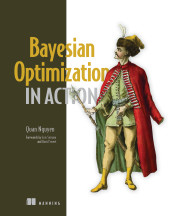
Bayesian Optimization in Action
A surrogate model is a predictive model that approximates an objective function from observed evaluations.
- How it is used
- Guides Bayesian optimization by predicting an objective from observed evaluations and quantifying uncertainty for decisions.
- How deep it goes
- Explains Gaussian-process probabilistic predictions, then develops multifidelity data formatting, correlation, cost modeling, and information-per-cost selection.
- Examples
- Uses ridge regression versus a Gaussian process, a Forrester approximation, neural-network early training, simulations, and Branin approximations.
- What you can do after
- Evaluate/understand when predictive uncertainty and cheaper approximate evaluations should guide expensive black-box optimization.
Read how Bayesian Optimization in Action explains surrogate model →

Outlier Detection in Python
A proxy model is an approximate model that imitates the behavior of another model or detector for analysis or explanation.
- How it is used
- Explains a black-box outlier detector by approximating its scores or labels with an interpretable model.
- How deep it goes
- Works through score regression, thresholded-label classification, cross-validation, tree-size limits, and interpretation rather than deriving surrogate algorithms.
- Examples
- Uses abalone Isolation Forest scores, 10-leaf decision trees, exported feature-threshold rules, and leaf-level outlier counts.
- What you can do after
- Apply it via scikit-learn to approximate detector outputs, check fidelity, and inspect interpretable paths without treating them as ground truth.
Read how Outlier Detection in Python explains surrogate model →
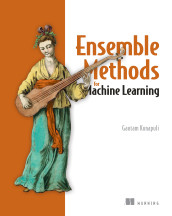
Ensemble Methods for Machine Learning
A surrogate model is an interpretable approximation trained to reproduce the behavior of a more complex model in a specified region or representation.
- How it is used
- Explains black-box ensemble behavior globally or individual predictions locally with interpretable approximations.
- How deep it goes
- Details surrogate-data construction, fidelity tradeoffs, decision trees, LIME weighting, and SHAP coalitions without deriving all optimization formulas.
- Examples
- Uses Bank Marketing XGBoost predictions, a 14-leaf decision-tree surrogate, and local explanations for test example 3104.
- What you can do after
- Evaluate/understand whether an interpretable model faithfully approximates a black box globally or near one prediction.
Read how Ensemble Methods for Machine Learning explains surrogate model →

Retrieval Augmented Generation, The Foundational Ideas
A proxy model is an approximate model used to estimate another model's behavior or to provide computationally cheaper scores for an input.
- How it is used
- Uses a small proxy to score and compress retrieved context before a larger generator answers.
- How deep it goes
- Explains the two-model split and operational tradeoffs, but stops short of deriving the scoring algorithms.
- Examples
- Demonstrates LLMLingua code, token-count analysis, benchmark results, and a legal indemnification case.
- What you can do after
- Apply it via LLMLingua to compress retrieved documents and inspect token reduction, latency, and answer-preservation tradeoffs.
Read how Retrieval Augmented Generation, The Foundational Ideas explains surrogate model →
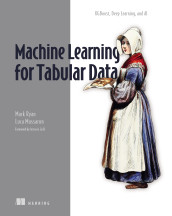
Machine Learning for Tabular Data: XGBoost, Deep Learning, and AI
A surrogate function is an approximate model of an objective function that predicts objective behavior across untested parameter settings.
- How it is used
- Guides Bayesian optimization toward promising machine-learning hyperparameters without exhaustively testing the search space.
- How deep it goes
- Explains updates, acquisition, exploration, exploitation, and model choices, but does not derive their mathematics.
- Examples
- Demonstrates Optuna tuning an XGBoost classifier and inspecting optimization history and hyperparameter importance.
- What you can do after
- Apply it via Optuna to search XGBoost hyperparameters and inspect the resulting best configuration and score.
Also covered in
- Financial AI in Practice
- Machines that ThinkIn early access (MEAP)
What to know first
- decision treeA decision tree is a tree-structured model or representation in which successive tests or choices lead through branches to outcomes, predictions, or actions.
- Gaussian processA Gaussian process is a probability distribution over functions in which every finite collection of function values has a joint Gaussian distribution.
- Bayesian optimizationBayesian optimization is a sequential method for optimizing an expensive or unknown objective by using a probabilistic model to guide evaluations.
- black boxA black box is a system or component whose internal workings are treated as opaque while its inputs, outputs, or observable behavior are considered.
Related concepts
- Optunaused by · Optuna is an open-source Python framework for automated hyperparameter optimization through repeated trials that explore parameter configurations.
- Bayesian optimizationused by · Bayesian optimization is a sequential method for optimizing an expensive or unknown objective by using a probabilistic model to guide evaluations.
- black boxuses · A black box is a system or component whose internal workings are treated as opaque while its inputs, outputs, or observable behavior are considered.
- interpretabilityused by · Interpretability is the degree to which people can understand a system’s structure, behavior, outputs, or the basis for its decisions.
- active learningused by · Active learning is a machine-learning approach in which a learner selects informative data examples for labeling or feedback to improve a model.
- labelcontrasts with · A label is a target value, category, or reference annotation associated with an example for learning, prediction, or evaluation.
Questions about surrogate model
What is surrogate model?
A surrogate model is an approximate model that estimates the behavior or outputs of a more complex, costly, or otherwise unavailable model, process, or function.
Which Manning books explain surrogate model?
Experimentation for Engineers, Build AI Drug Discovery Pipelines, Bayesian Optimization in Action, Outlier Detection in Python, Ensemble Methods for Machine Learning, Retrieval Augmented Generation, The Foundational Ideas and Machine Learning for Tabular Data: XGBoost, Deep Learning, and AI.
What should I know before learning surrogate model?
Manning books that teach surrogate model usually introduce decision tree, Gaussian process, Bayesian optimization and black box first.
What is the difference between surrogate model and label?
A surrogate model is an approximate model that estimates the behavior or outputs of a more complex, costly, or otherwise unavailable model, process, or function. A label is a target value, category, or reference annotation associated with an example for learning, prediction, or evaluation.
What is surrogate model also called?
Surrogate model is also called surrogate function.
These guides are generated from the text of Manning books by Manning's knowledge graph and link to the sections they draw on. The full books are available on liveBook and at manning.com.