A surrogate model is an interpretable glass-box model trained to mimic a complex black-box model. Rather than learning the original target, it learns the black box’s predictions, so its structure can be inspected as an explanation of the black box’s behavior. A decision tree or generalized linear model can serve as the surrogate. section 9.3.3 section 9.6
The central question is fidelity: does the surrogate make predictions sufficiently similar to the black box? Training therefore balances fidelity against interpretability. A larger decision tree may reproduce more of the ensemble’s behavior, but its added depth and leaf nodes make it harder to understand; a smaller tree is clearer but may omit important behavior. section 9.3.3 section 9.6
A global surrogate explains behavior across a problem space:
- Choose surrogate examples with the same distribution as the examples used for the black box; use the original training data when available or an alternate representative sample. section 9.3.3
- Run the black box on those examples and use its predictions as labels for the surrogate training set. section 9.3.3
- Fit an interpretable model, then assess whether its predictions match the black box closely enough before using it as an explanation. section 9.3.3
- Inspect the fitted glass box—for example, its decision paths or feature weights—to obtain a holistic account of the black box’s learned behavior. section 9.3.3 section 9.6
Figure 9.11 The procedure to train a global surrogate model from the predictions of a black-box model. Both models are trained on the same surrogate training examples. However, the surrogate model is trained on the predictions of the black-box model, so that it can learn to mimic its predictions. If the black box and surrogate make the same prediction, then the surrogate can be used to explain the black-box model’s prediction.
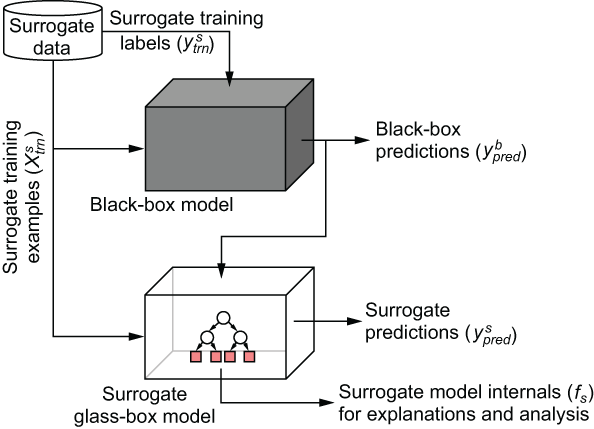
The diagram separates the original prediction task from the explanation task: both models see the same examples, but only the surrogate is trained to reproduce the black box’s outputs. section 9.3.3
Explaining an XGBoost classifier globally
For Bank Marketing predictions, train a decision-tree classifier on the original examples paired with XGBoost predictions. Restricting the tree to 14 leaf nodes makes it inspectable, while the resulting tree can reveal explanatory paths from its root to a leaf. The chosen size represents a practical compromise, not proof that the tree exactly captures the ensemble. section 9.3.3
A local surrogate answers a narrower question: why did the black box make this prediction for this example? LIME fits a linear model near the example of interest. It creates perturbed surrogate examples, gives closer examples greater weight, and fits the linear model to approximate local black-box behavior. Its coefficients express local feature contributions rather than a global description. section 9.4.1 section 9.6
Figure 9.14 LIME creates a surrogate training set of examples in the locality of the example whose prediction needs to be explained. These examples are further weighted by their distance. This is indicated by the sizes of the surrogate examples, with closer examples getting higher weights (and shown larger). A weighted loss function is used to fit a linear surrogate model, which provides local explanations.
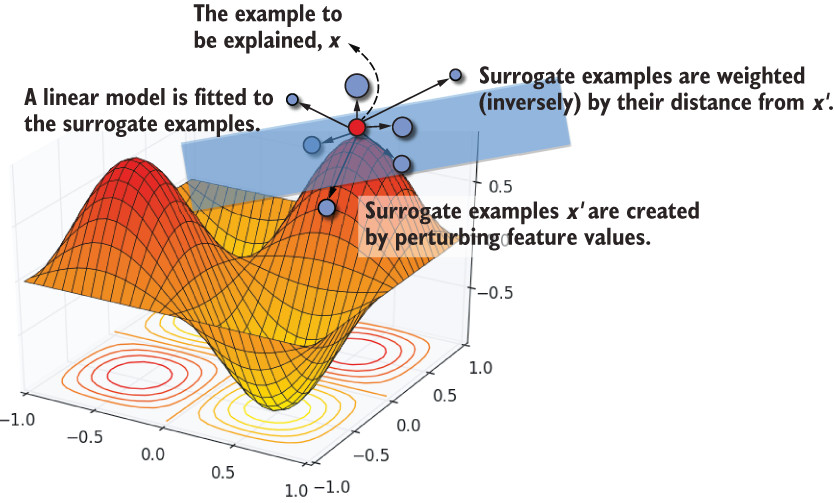
Nearby perturbed examples receive higher weight, letting the linear surrogate prioritize fidelity around one prediction instead of across the full data distribution. section 9.4.1
SHAP likewise uses a local linear surrogate, but constructs examples through feature coalitions. A coalition vector marks which feature values come from the example being explained; absent features are replaced with values from another sampled example. This approximation avoids directly training a model for every possible feature coalition, which grows infeasibly with the number of features. For tree-based models, TreeSHAP computes Shapley values efficiently. section 9.4.2 section 9.6
Surrogates are explanations of a model, not necessarily explanations of the real-world process behind the model. Their usefulness depends on representative surrogate data and adequate fidelity. Global trees summarize overall behavior; LIME and SHAP focus on individual predictions. LIME and SHAP are designed for individual feature importance and do not fundamentally evaluate feature interactions. section 9.3.3 section 9.6




