liveBook · Manning

Behavioral finance

As explained in Investing for Programmers

Behavioral finance is the study of how psychological factors and behavioral biases influence financial decisions and markets.

Behavioral finance studies how psychological factors and behavioral biases shape financial decisions and markets. Overconfidence and loss aversion can make emotions and unconscious behavior obstacles to financial freedom. section 8.1

Key implications for investment automation include:

  • Recognizing human irrationality does not make machine learning a complete solution: automated models can be opaque, fail after market changes, and still expose investors to losses. section 8.1
  • Managing behavior can require control measures alongside technical tools, rather than assuming algorithms remove every investment risk. section 13.0
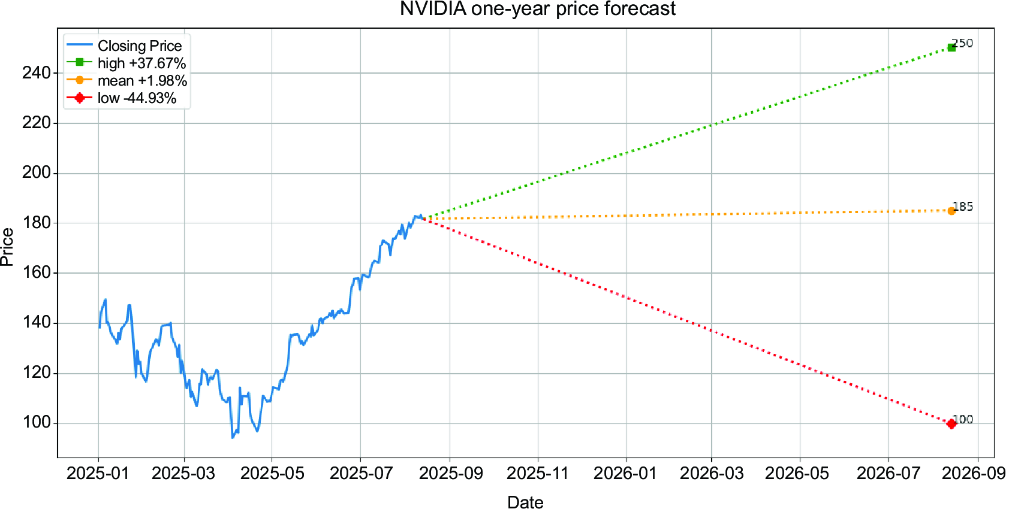
Figure 8.1 One-year price forecasts for NVIDIA based on data collected via yfinance, divided into high, low, and mean
figure

Forecast ranges illustrate how automated financial analysis can present uncertainty rather than guarantee profitable decisions. section 8.1

How Investing for Programmers covers it

How deep it goes
Defines overconfidence and loss aversion, then connects them to machine-learning automation without developing a detailed behavioral model.
Examples
Uses overconfidence, loss aversion, opaque trading bots, and one-year NVIDIA price forecasts as concrete illustrations.
What it assumes
Assumes basic exposure to investing while introducing behavioral biases and their relationship to automated decision-making.
What you can do after
Evaluate how bias and automation can influence investment decisions without treating model outputs or trading profits as guarantees.
How it connects
Connects behavioral finance with loss aversion, overconfidence, machine learning, algorithmic trading, and information security.

This explainer was generated by Manning's knowledge graph from the text of Investing for Programmers. The section links point to the parts of the book it draws on.