A Bell state is one of four orthogonal two-qubit states formed from pairs of computational-basis states: ψ₀ = (|00⟩ + |11⟩)/√2, ψ₁ = (|00⟩ − |11⟩)/√2, ψ₂ = (|01⟩ + |10⟩)/√2, and ψ₃ = (|01⟩ − |10⟩)/√2. Each basis state occurs in two Bell states, yet the four resulting states remain orthogonal. section 4.3
Distinguish Bell states with a Bell measurement. Apply CNOT from the first qubit to the second, then apply Hadamard to the first qubit; computational-basis measurement returns the state index under little-endian interpretation. section 4.3.1
The state-preparation and measurement relationship is:
- |00⟩, |10⟩, |01⟩, and |11⟩ map through Hadamard-plus-CNOT preparation to ψ₀, ψ₁, ψ₂, and ψ₃ respectively. section 4.3.1
- Measurement needs only the inverse circuit when the post-measurement qubit state is irrelevant; otherwise, apply the adjoint again to restore the corresponding measurement-basis state. section 4.3.1
- A single-qubit Hadamard-and-measurement strategy cannot determine the relative sign of an entangled Bell pair from one qubit alone. section 6.5.1
Implementing Bell-state discrimination
In Qiskit, construct a two-qubit circuit with cx(0, 1), h(0), and measurements of both qubits. In Q#, apply CNOT(qs[0], qs[1]), H(qs[0]), and read the result with ReadInformationInt. Tests prepare each Bell state and expect a passing discrimination result. section 4.3.2 section 4.3.3
Figure 4.5 Performing a measurement in a noncomputational basis, using the Bell measurement as an example. First, we apply an operation that maps the basis states of the measurement basis (in this case, the Bell states) to the computational basis states. Then, we measure the qubits in the computa-tional basis and interpret the measurement results. Finally, if the state of the system after the measure-ment has to match the measurement outcome, we apply the adjoint of the operation we applied in the first step.
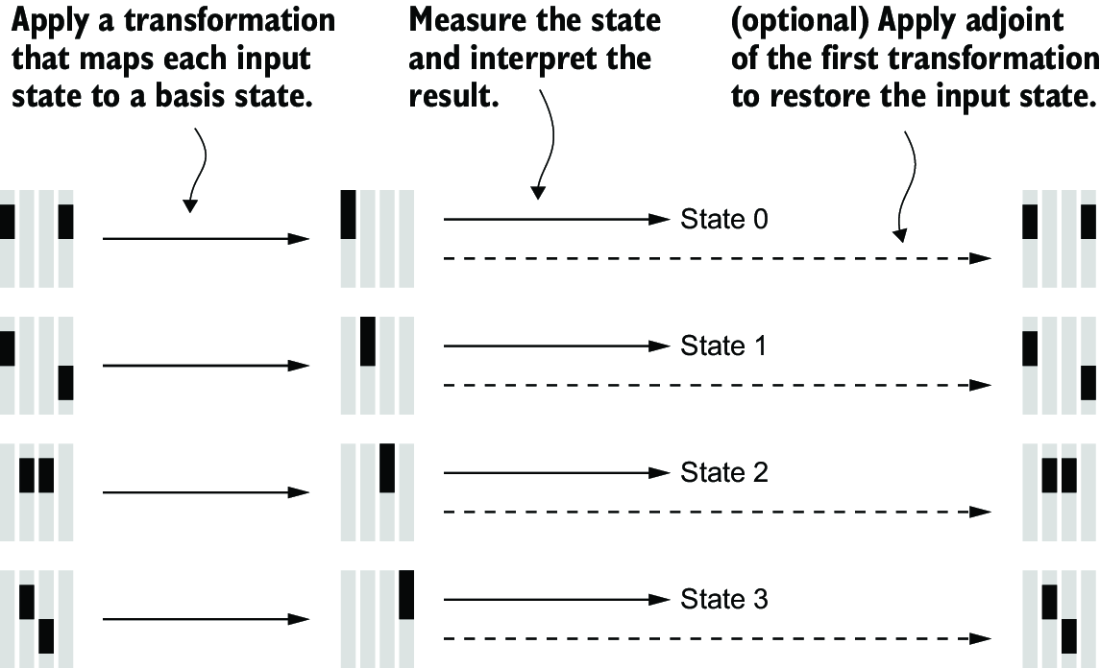
Use the circuit diagram to trace noncomputational-basis measurement through basis transformation, computational measurement, result interpretation, and optional uncomputation. section 4.3.1

