liveBook · Manning

Betweenness centrality

As explained in Knowledge Graphs and LLMs in Action

Betweenness centrality is a graph metric based on how often a node lies on shortest paths between other nodes.

Betweenness centrality measures how often a node appears on shortest paths between other node pairs. High-scoring nodes act as bridges and may influence information flow. section 10.1.6

Use the metric to:

  • Highlight connectors between otherwise weakly connected research communities. section 6.2
  • Find potential bottlenecks, vulnerabilities, and nodes worth monitoring in fraud networks. section 10.1.6
  • Compare a node’s bridging role with closeness centrality’s measure of reachability. section 10.1.6

Fraud-network analysis

Compute scores with NetworkX, optionally normalize them to 0–1, round results, and identify key bridges by selecting nodes above the average score. Node A is a prominent bridge in the illustrated fraud graph, while several nodes score zero. section 10.1.6

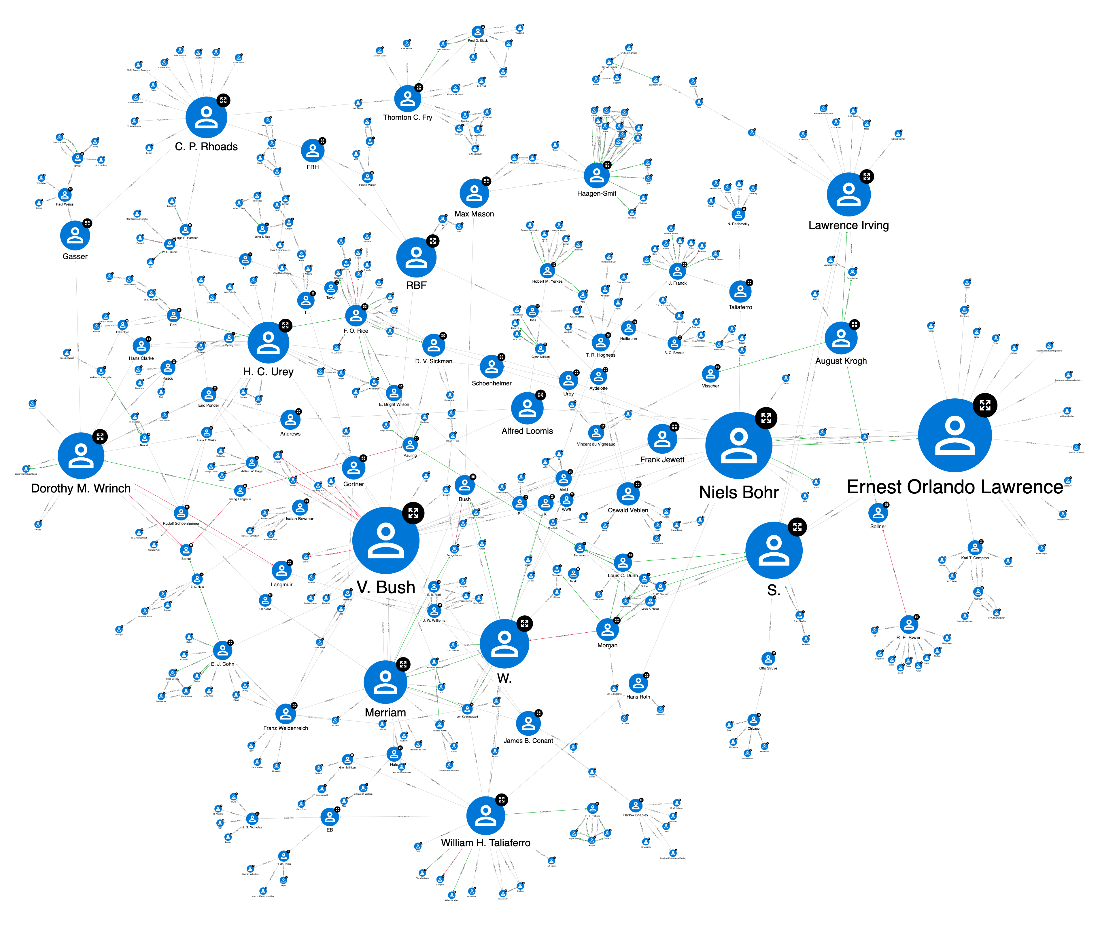
Figure 6.4 The intellectual influence network comprises the relations TALKED_ABOUT, TALKED_WITH, WORKS_WITH, and STUDENT_OF. Node styling is based on their betweenness centrality score.
figure

Explore an intellectual influence network whose node sizes reflect betweenness centrality, making bridge-like researchers visually prominent. section 6.2


How Knowledge Graphs and LLMs in Action covers it

How deep it goes
Defines shortest-path counting, gives the path-ratio formula, and implements normalized NetworkX scores without deriving the algorithm internally.
Examples
Uses researcher influence graphs, cyclotron-related networks, and a fraud graph containing high-, low-, and zero-scoring nodes.
What it assumes
Assumes graph nodes, node pairs, shortest paths, and basic network metrics while contrasting the concept with closeness centrality.
What you can do after
Diagnose/debug with it: compute bridge scores, summarize their distribution, and flag nodes above the network average.
How it connects
Connects graph analytics with closeness centrality, PageRank, eigenvector centrality, node degree, and fraud detection.

Also explained in

Compare how 3 books explain betweenness centrality →

Related concepts

This explainer was generated by Manning's knowledge graph from the text of Knowledge Graphs and LLMs in Action. The section links point to the parts of the book it draws on.
