BGP is an exterior gateway protocol (EGP) that uses a path-vector algorithm to calculate routes between autonomous systems (ASes). It makes routing decisions from the sequence of ASes a packet crosses rather than individual routers, making it suitable for large-scale routing. section 17.2.2 section 17.5
Key points:
- Treats the route as a path through autonomous systems, such as two interconnected ISPs. section 17.2.2
- Considers multiple path attributes rather than only counting autonomous systems. section 17.2.2
- Differs from distance-vector and link-state IGPs, which use neighbor information or a network connectivity map. section 17.5
AS-to-AS path
When R1 needs to reach Enterprise B, it learns a BGP route through ISP A and ISP B. The path is evaluated as an AS sequence, not as a list of every router along the way. section 17.2.2
Figure 17.10 R1’s path to Enterprise B passes through ISP A and ISP B and then arrives at Enterprise B. Path-vector logic is AS-to-AS, rather than router-to-router.
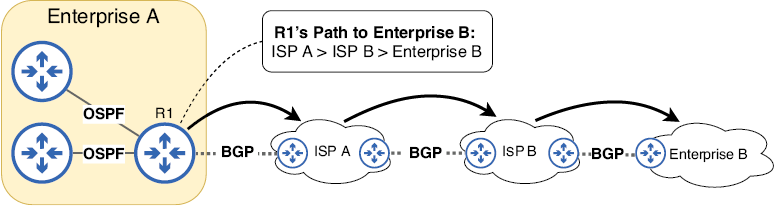
Use the diagram to visualize how BGP represents an inter-AS route. section 17.2.2
