An exterior gateway protocol (EGP) exchanges routing information between autonomous systems (ASes), such as an enterprise and an ISP or two ISPs. Interior gateway protocols serve routing within one AS; EGPs connect separate organizations. section 17.2
Use these distinctions to recognize EGPs in routing scenarios:
- Identify Border Gateway Protocol (BGP) as the only EGP widely used in modern networks. section 17.2.2
- Recognize BGP as a path-vector protocol: it evaluates paths through autonomous systems rather than individual routers. section 17.2.2
- Remember that BGP considers multiple path attributes, not merely the number of autonomous systems. section 17.2.2
Enterprise-to-enterprise route
R1 in Enterprise A learns a route to Enterprise B through ISP A and ISP B using BGP. The route is considered as an AS sequence, not as a list of individual routers. section 17.2.2
Figure 17.5 IGPs are used to exchange routing information with routers in the same AS (connected with solid lines). EGPs are used to exchange routing information with routers in a different AS (connected with dotted lines).
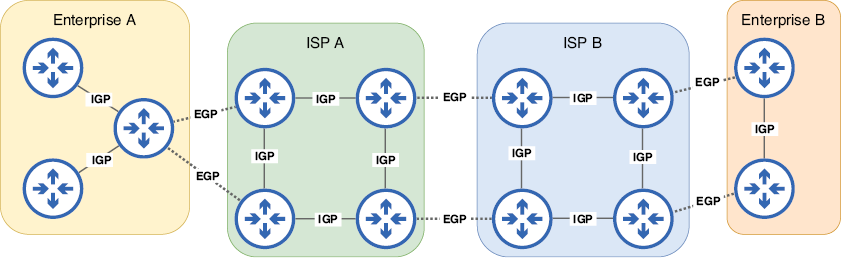
Compare IGP links within an autonomous system with EGP links between autonomous systems. section 17.2
Figure 17.10 R1’s path to Enterprise B passes through ISP A and ISP B and then arrives at Enterprise B. Path-vector logic is AS-to-AS, rather than router-to-router.
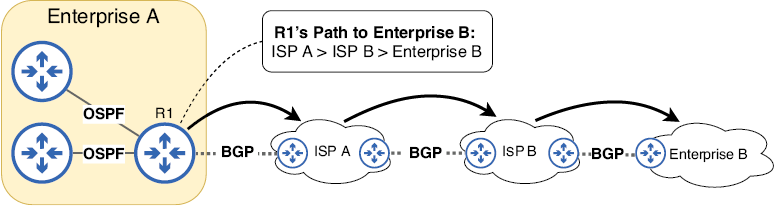
Trace the AS-to-AS path from R1 through two ISPs to Enterprise B. section 17.2.2
