An interior gateway protocol (IGP) exchanges routing information within one autonomous system, such as an organization’s network. An exterior gateway protocol exchanges information between autonomous systems, such as an enterprise and an ISP. Although gateway is an older term for router, it remains in networking terminology. section 17.2
Classify IGPs by the algorithm they use to share information and calculate routes:
- Distance-vector protocols include RIP and EIGRP. Routers share known networks, metrics, and next-hop information rather than a complete network map. section 17.2.1
- Link-state protocols include OSPF and IS-IS. Routers build a connectivity map and use it to calculate routes. section 17.2 section 17.5
- RIP is simple and suited mainly to small networks and labs; EIGRP is more advanced and used in many large-scale networks. section 17.2.1
Choosing a distance-vector route
If R1 learns about LAN A from R2 with metric 2 and from R5 with metric 1, it installs the route through R5 because the lower metric is preferred. R1 knows the next hop and metric, not the network details beyond those neighbors. section 17.2.1
Figure 17.5 IGPs are used to exchange routing information with routers in the same AS (connected with solid lines). EGPs are used to exchange routing information with routers in a different AS (connected with dotted lines).
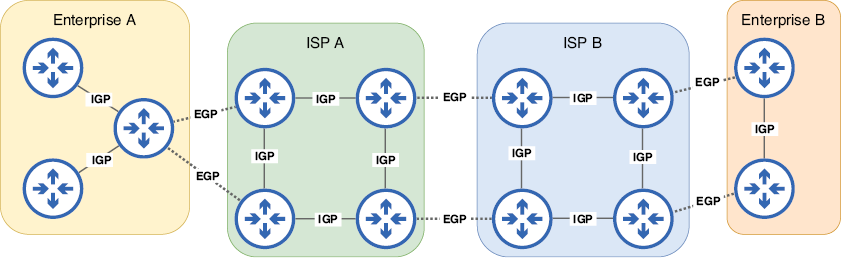
Use the topology diagram to distinguish routing within one autonomous system from routing between autonomous systems. section 17.2
