Bias mitigation applies methods that reduce systematic unfairness or distortion in training data, model behavior, and generated outputs. In generative AI systems, it is a governance and engineering concern rather than a single model adjustment. section 9.7.2 section 13.3.3
Practical mitigation combines several controls:
- Use diverse and representative data to improve fairness and reduce dataset bias. section 13.3.3
- Detect and mitigate bias in both training data and model outputs. section 13.3.3
- Add human oversight, evaluator cross-validation, monitoring, and continuous evaluation. section 9.7.2 section 13.3.3
- Layer model, safety-system, and application controls, including red-teaming and output filtering. section 13.3.3
Bias mitigation during RLHF
When scaling reinforcement learning from human feedback, use intelligent sampling to prioritize valuable evaluation instances, distribute evaluator work, cross-check feedback, and monitor model performance. These controls help prevent feedback from reinforcing harmful stereotypes. section 9.7.2
Figure 13.11 Harms mitigation layers
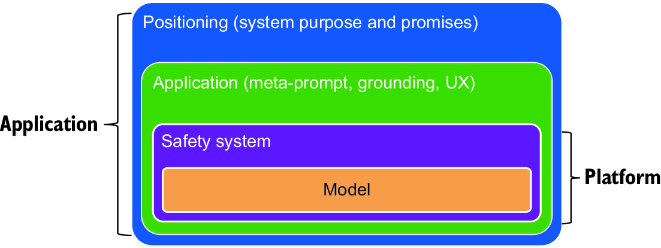
Use the harms-mitigation layers to examine how model, safety-system, and application controls work together as defense in depth. section 13.3.3

