A binary counterfactual query asks about hypothetical conditions and outcomes that each have two states, such as treatment versus control, exposed versus unexposed, or an event occurring versus not occurring. Binary form often makes counterfactual reasoning simpler and can turn a continuous question into a thresholded one. section 8.3
Thresholding a purchase question
Suppose a player spends $152.34. Instead of asking why the exact amount occurred, ask why the player spent more than $120. Define X = 1 when spending exceeds $120 and X = 0 otherwise. The resulting query concerns a binary outcome while preserving the business question about unusually high spending. section 8.3
Binary counterfactuals support causal attribution through probabilities of necessity, sufficiency, and necessity-and-sufficiency. They also clarify uplift modeling: comparing whether a person churns with and without a promotion separates persuadables, sure things, lost causes, and sleeping dogs, helping target limited influence efforts. section 8.3.3 section 8.5
Figure 8.5 In attempts to influence behavior, we break down the target population into these four segments. Given limited resources, we want to target our influence efforts on the persuadables and avoid the others, especially the sleeping dogs.
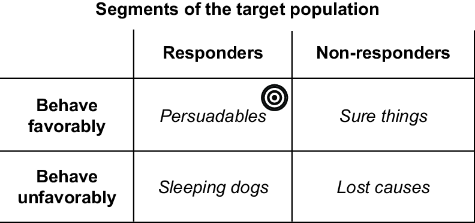
Use the population segmentation figure to compare the four counterfactual response types and identify whom an intervention should target or avoid. section 8.3.3
