liveBook · Manning

Binary data

As explained in Data Without Labels

Binary data has exactly two mutually exclusive possible categories or values.

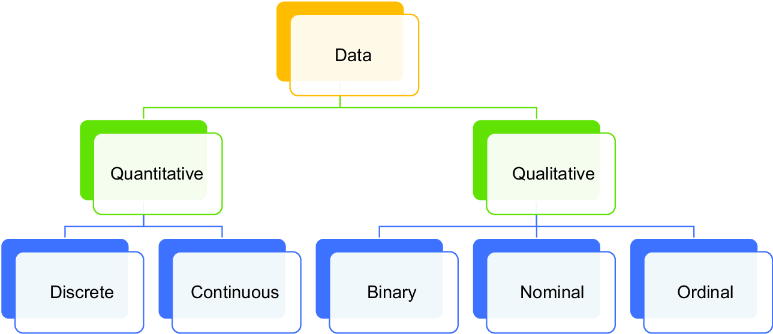
Binary data is qualitative, or categorical, data with exactly two mutually exclusive classes. It belongs to the qualitative branch alongside nominal and ordinal data. section 1.2.2

Common binary pairs include:

  • yes/no, dry/wet, hard/soft, good/bad, and true/false section 1.2.2
Figure 1.2 The divisions and subdivisions of data
figure

Use the data-classification diagram to place binary data within qualitative and quantitative data types. section 1.2.2


How Data Without Labels covers it

How deep it goes
Defines two-class categorical data and distinguishes it from nominal, ordinal, discrete, and continuous data.
Examples
Uses yes/no, dry/wet, hard/soft, good/bad, and true/false as paired class examples.
How it connects
Relates to qualitative data, categorical variables, nominal data, ordinal data, quantitative data, discrete data, and continuous data.

Also explained in

Compare how 4 books explain binary data →

Related concepts

This explainer was generated by Manning's knowledge graph from the text of Data Without Labels. The section links point to the parts of the book it draws on.

