A binding mode is a predicted spatial arrangement and interaction pattern between a ligand and a protein binding site. Docking searches possible ligand orientations and conformations, then identifies the arrangement with the most favorable score. section 9.1.1 section 9.1.2
The score ranks candidate poses using factors such as van der Waals and electrostatic interactions, hydrogen bonding, and desolvation. A favorable pose suggests a stable interaction, but flexible proteins and ligands make the search a difficult three-dimensional optimization problem. section 9.1.2
A practical docking workflow typically includes:
- Preparing the input protein-ligand structure and separating its components. section 9.1.2
- Preparing the receptor and ligand, then defining the binding site from ligand coordinates. section 9.1.2
- Sampling poses, ranking them, and analyzing interactions in the docked complexes. section 9.1.2
Figure 9.2 Schematic overview of our protein-ligand docking workflow for structure-based drug design, illustrating a pipeline from obtaining the initial protein-ligand structure to analyzing molecular interactions in the docked complexes. The process consists of three main stages: (1) Input Preparation, where the EGFR-ligand complex structure is obtained from the PDB database and separated using MDTraj; (2) Structure Preparation, involving receptor preparation with PDBFixer, ligand preparation with Meeko, and binding site definition based on ligand coordinates; and (3) Docking & Analysis, where AutoDock Vina performs conformational sampling and pose evaluation, followed by post-processing and interaction analysis using ProLIF. Dark blue rectangles represent computational tools, while rectangles indicate processes within the docking engine, and light blue rectangles represent the data files we reference throughout this chapter’s Python notebook.
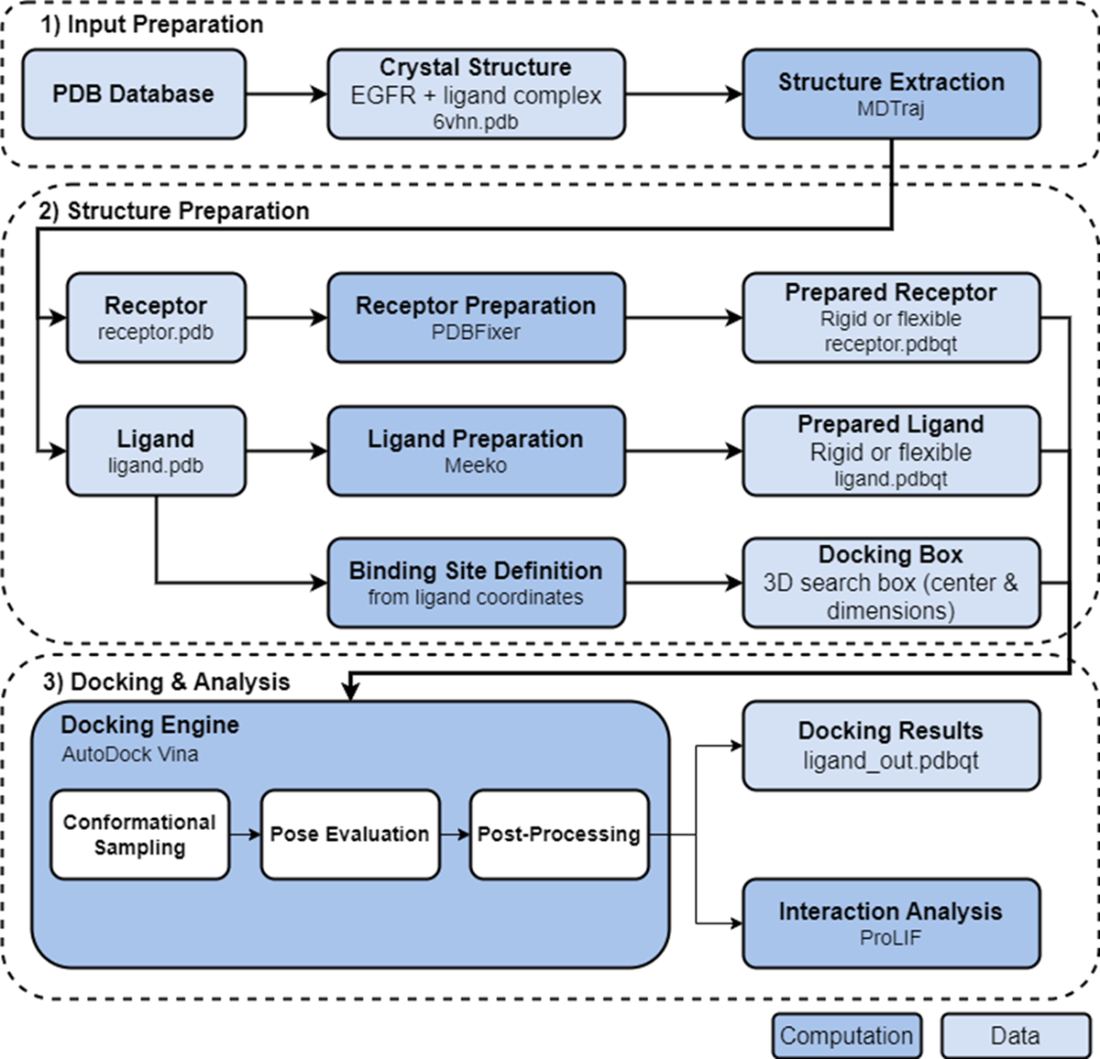
Trace the complete EGFR-ligand workflow from PDB input through MDTraj, PDBFixer, Meeko, AutoDock Vina, and ProLIF analysis. section 9.1.2
