Molecular docking simulates how a ligand—a molecule that binds a target—might fit into a protein’s binding site. It explores possible arrangements and estimates how favorably they interact, helping prioritize compounds and poses for further evaluation. section 1.3.1 section 9.1.1
A pose is a possible three-dimensional geometry of the protein–ligand complex. Docking combines conformational sampling, which searches possible poses, with a scoring function that ranks them. Scores can account for interactions such as hydrogen bonding and electrostatic forces. The aim is to find a favorable pose, but both molecules can change shape, making the search difficult. section 9.1.2
A minimal protein–ligand docking workflow has three stages:
- Obtain a protein–ligand structure and separate the receptor and ligand. section 9.1.2
- Prepare both structures and define a binding box around the site of interest. section 9.1.2 section 9.1.1
- Sample and score poses, then inspect the resulting molecular interactions. section 9.1.2
Docking an EGFR ligand
For an EGFR protein–ligand complex from the PDB, MDTraj separates the components. PDBFixer prepares the receptor, Meeko prepares the ligand, and ligand coordinates define the binding site. AutoDock Vina samples and scores poses; ProLIF supports subsequent interaction analysis. section 9.1.2
Figure 9.2 Schematic overview of our protein-ligand docking workflow for structure-based drug design, illustrating a pipeline from obtaining the initial protein-ligand structure to analyzing molecular interactions in the docked complexes. The process consists of three main stages: (1) Input Preparation, where the EGFR-ligand complex structure is obtained from the PDB database and separated using MDTraj; (2) Structure Preparation, involving receptor preparation with PDBFixer, ligand preparation with Meeko, and binding site definition based on ligand coordinates; and (3) Docking & Analysis, where AutoDock Vina performs conformational sampling and pose evaluation, followed by post-processing and interaction analysis using ProLIF. Dark blue rectangles represent computational tools, while rectangles indicate processes within the docking engine, and light blue rectangles represent the data files we reference throughout this chapter’s Python notebook.
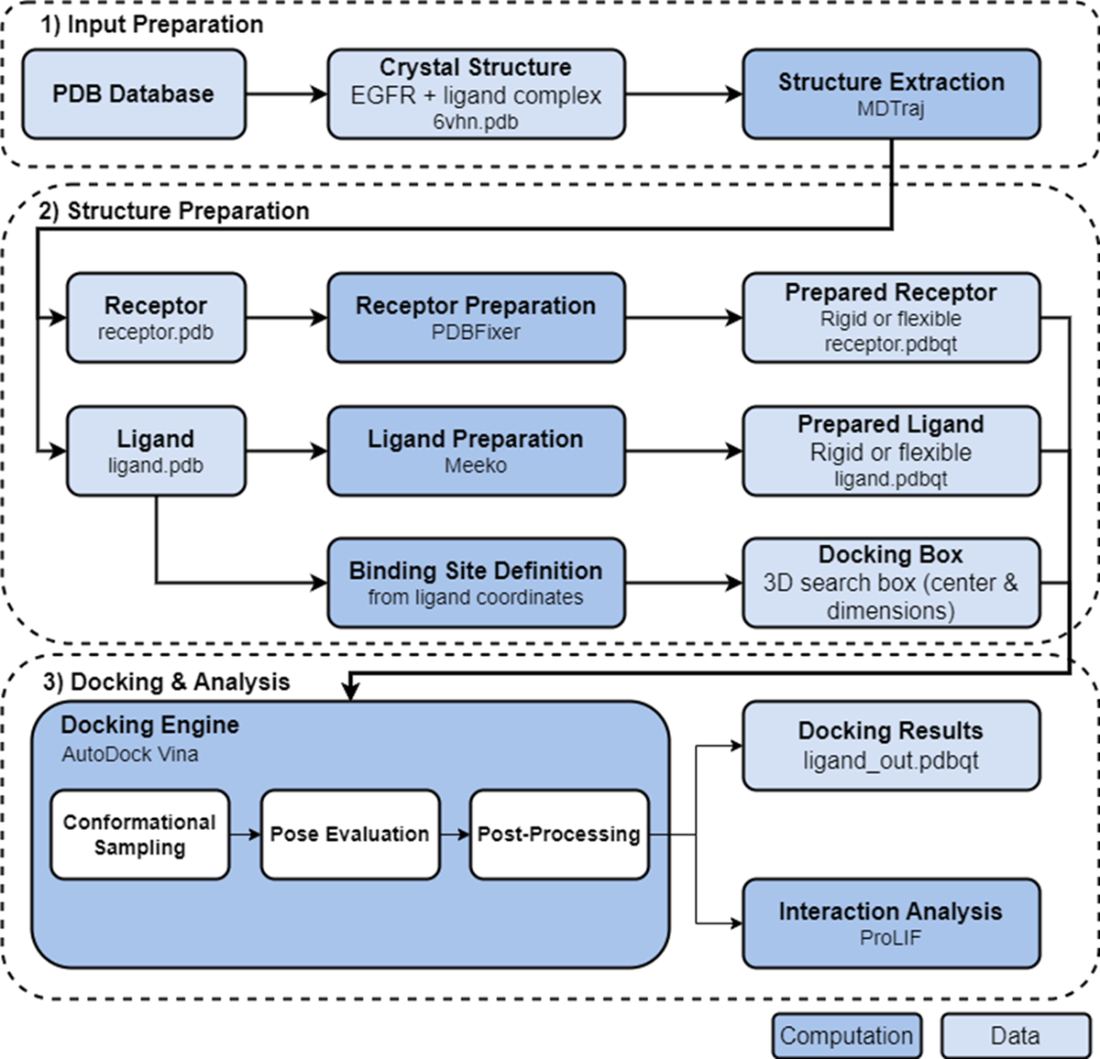
Follow the EGFR workflow from structure preparation through docking and interaction analysis. section 9.1.2
A Vina score ranks poses and compounds, with lower scores preferred. It is an estimate from a scoring function, not a measured binding free energy or a calibrated probability. Compare the top pose with a crystallographic pose as a control, consider rescoring or short molecular dynamics simulations, and ultimately validate experimentally: a good score can come from a bad pose. section 9.1.1
Results depend on preparation choices, including protonation, tautomers, waters, and metals. A rigid-receptor assumption and uncertainty in the underlying protein structure can also affect results. Docking is computationally expensive, so screening pipelines often filter compounds first. Progressive docking can instead train a surrogate on scores from a subset, then use its predictions to select further compounds for docking. section 9.1.1 section 2.1.1 section 9.0
