Structure-based drug design uses a biological target’s three-dimensional structure to guide the discovery and optimization of molecules that bind and modulate it. Molecular docking estimates binding poses and scores, enabling computational screening of large compound libraries. section 9.0 section 9.1
A practical structure-based screening workflow typically:
- Obtains and prepares a protein structure determined through X-ray crystallography, cryo-EM, NMR, or another structural method. section 9.1
- Prepares ligands, defines a binding site, docks compounds, and analyzes predicted protein–ligand interactions. section 9.4
- Uses docking scores to prioritize promising candidates, while treating those scores as approximate rather than definitive binding measurements. section 9.0
- Scales screening with a surrogate model and active learning, docking selected compounds while predicting scores for the rest. section 9.0 section 9.4
Figure 2.1 Virtual screening pipelines are often hierarchical, proceeding with a broad, large number of compounds through simpler, less restrictive, and computationally cheaper processes to whittle down the quantity of compounds. If the 3D structure of the target is not defined, we’re restricted to ligand-based virtual screening. If it is defined, then we can explore structure-based virtual screening, potentially as a downstream component to ligand-based virtual screening.
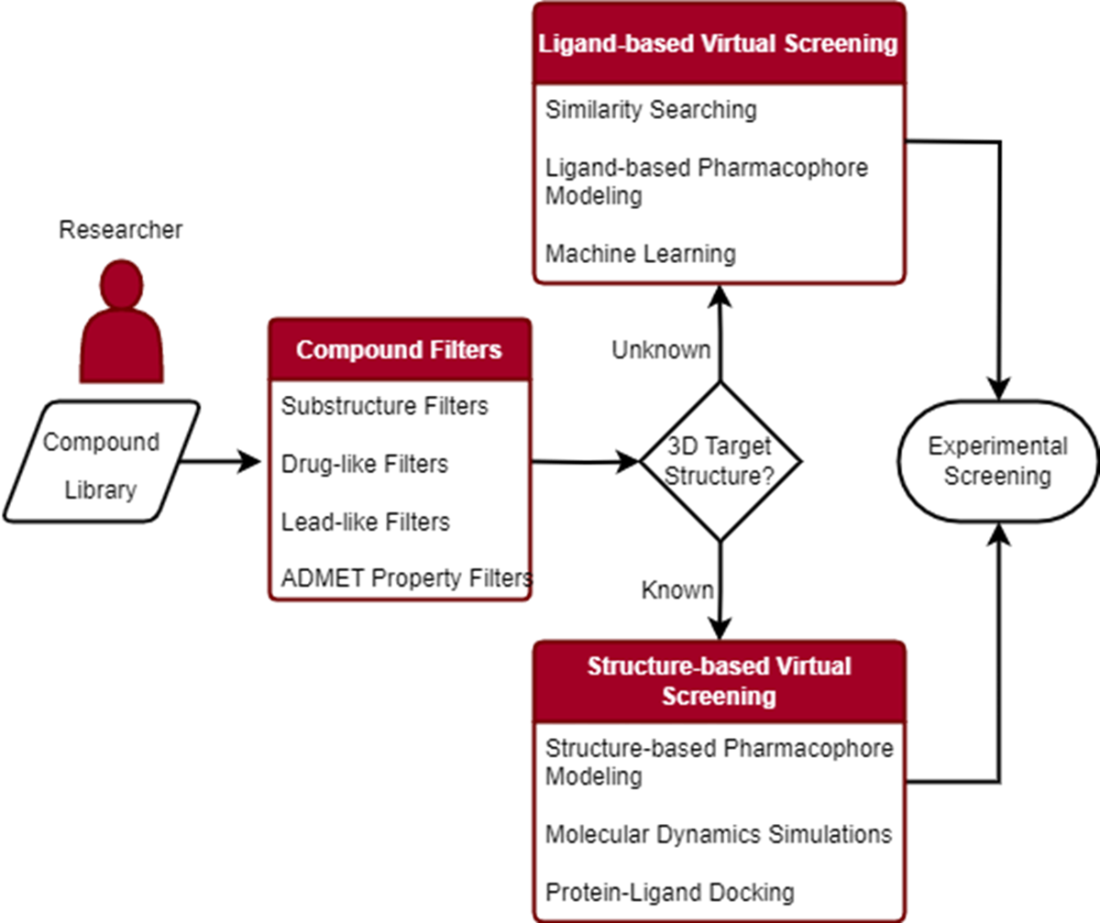
Use the hierarchical pipeline to compare inexpensive broad filtering with downstream structure-based screening when a defined target structure is available. section 2.1.1
Active learning for kinase screening
A complete workflow can prepare an EGFR target and ligands, dock them with AutoDock Vina, and analyze interaction fingerprints. For a VEGFR-2 library identified by PDB ID 4AG8, active learning recovered 73 of the top 100 compounds after ten iterations while docking only a small fraction of the library. section 9.4
