A molecular target is a biomolecule whose activity can be modulated to produce a desired medicinal effect. Targets include proteins, DNA, RNA, lipids, and carbohydrates. Drug discovery searches for compounds that bind a chosen target rather than examining every possible compound–biomolecule pair. section 1.1.1
Binding is a physical interaction, not a rigid lock-and-key event. A target and candidate molecule sample changing three-dimensional conformations, adjust toward a lower-free-energy arrangement, and form an association characterized by binding affinity. Alternative splicing, modifications, and sequence variation create many distinct proteoforms that may also bind molecules unintentionally. section 1.1.1
RNA as a challenging target
Small molecules can bind RNA to inhibit RNA–protein interactions, alter splicing, or promote RNA degradation. RNA targets are difficult because they provide fewer obvious binding pockets, interconvert among conformations, and contain repeated similar motifs, making selective binding and predictive modeling challenging. section 6.0
For protein targets, molecular docking explores ligand orientations and conformations inside active or allosteric sites. Scoring estimates favorable binding modes using factors such as complementarity, affinity, and interaction stability; binding can inhibit normal substrate interactions or alter protein function allosterically. section 9.1.1
Figure 1.1 Drug discovery can be thought of as a difficult search problem that exists at the intersection of the chemical search space of 1063 drug-like compounds and the biological search space of 105 targets.
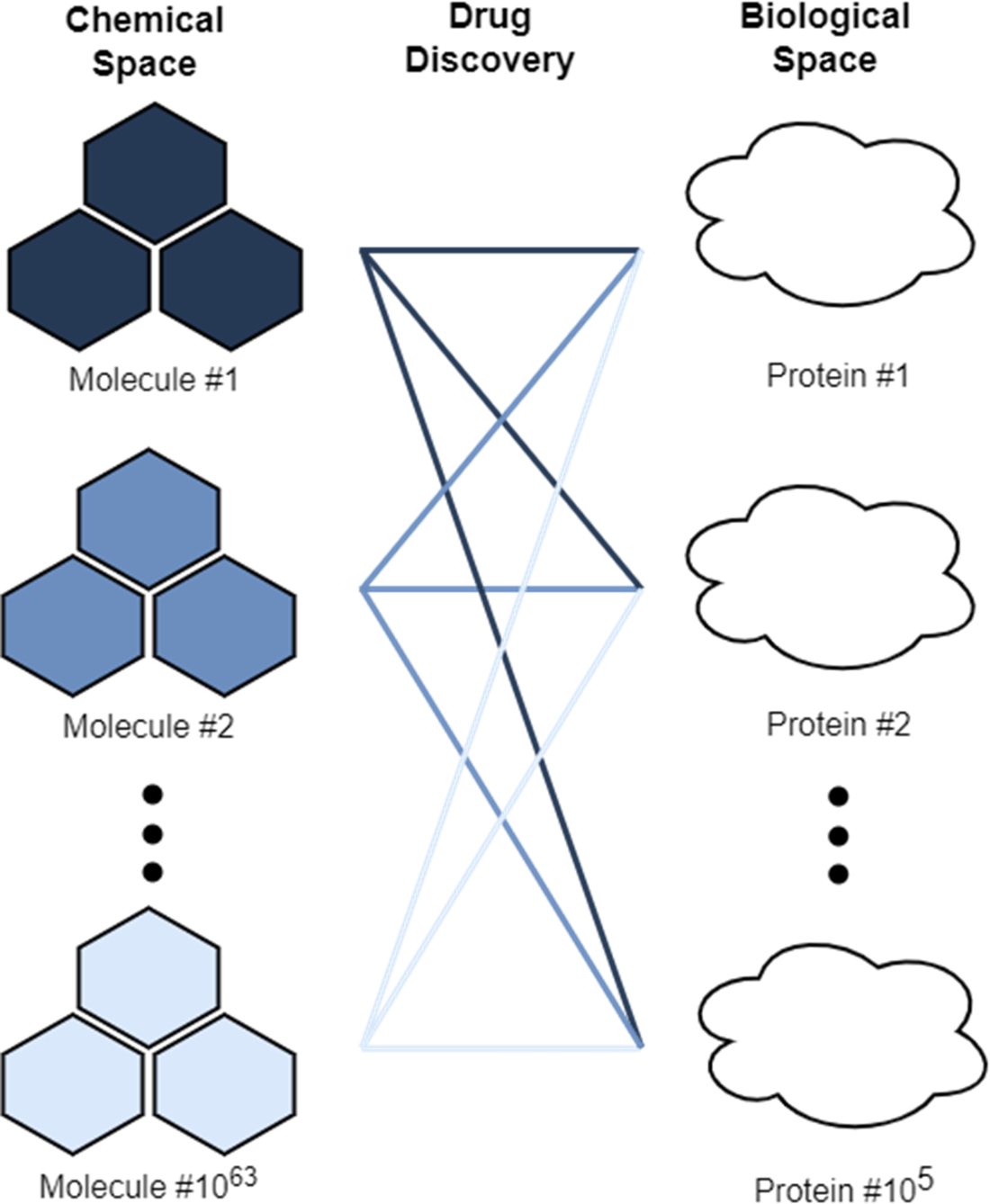
Visualizes drug discovery as an intersection between the enormous chemical search space and the biological search space of potential targets. section 1.1.1
