Target identification finds a biological molecule associated with a disease mechanism and worth modulating therapeutically. Selecting the target focuses later design on compounds that bind it and alter its activity. section 1.4.1
The choice is rarely obvious because disease biology may be only partly understood. Computational systems can assemble and rank candidate targets from scientific literature or multi-omics data, but human experts must scrutinize the evidence and validate whether modulation could limit disease progression. section 1.4.1 section 13.4
Target identification sits at the beginning of the early discovery workflow:
- Identify or select a disease-associated biomolecule. section 1.4
- Validate the target’s relationship to disease and its therapeutic potential. section 1.4.1
- Discover active compounds through virtual screening or high-throughput screening. section 1.4.1
- Advance promising hits through lead identification and lead optimization, including potency, selectivity, safety, and ADMET considerations. section 1.5
From disease mechanism to target
For disease X, a target is a biomolecule linked to an underlying mechanism. A compound that binds the target resembles a key fitting a lock, but binding may change enzyme shape and function. Unintended binding to other biomolecules creates an off-target effect. TNIK in idiopathic pulmonary fibrosis illustrates a stronger case of computationally emerging biology because it had little prior disease literature and no selective inhibitors. section 1.4.1 section 13.4
Figure 1.11 We can breakdown drug design into target identification and validation, hit discovery, hit-to-lead (lead identification), lead optimization, and preclinical development. Once a drug candidate has progressed to the drug development stage, it will need to pass multiple phases of clinical trials testing safety and efficacy prior to submission to and review by the FDA and launch to market.
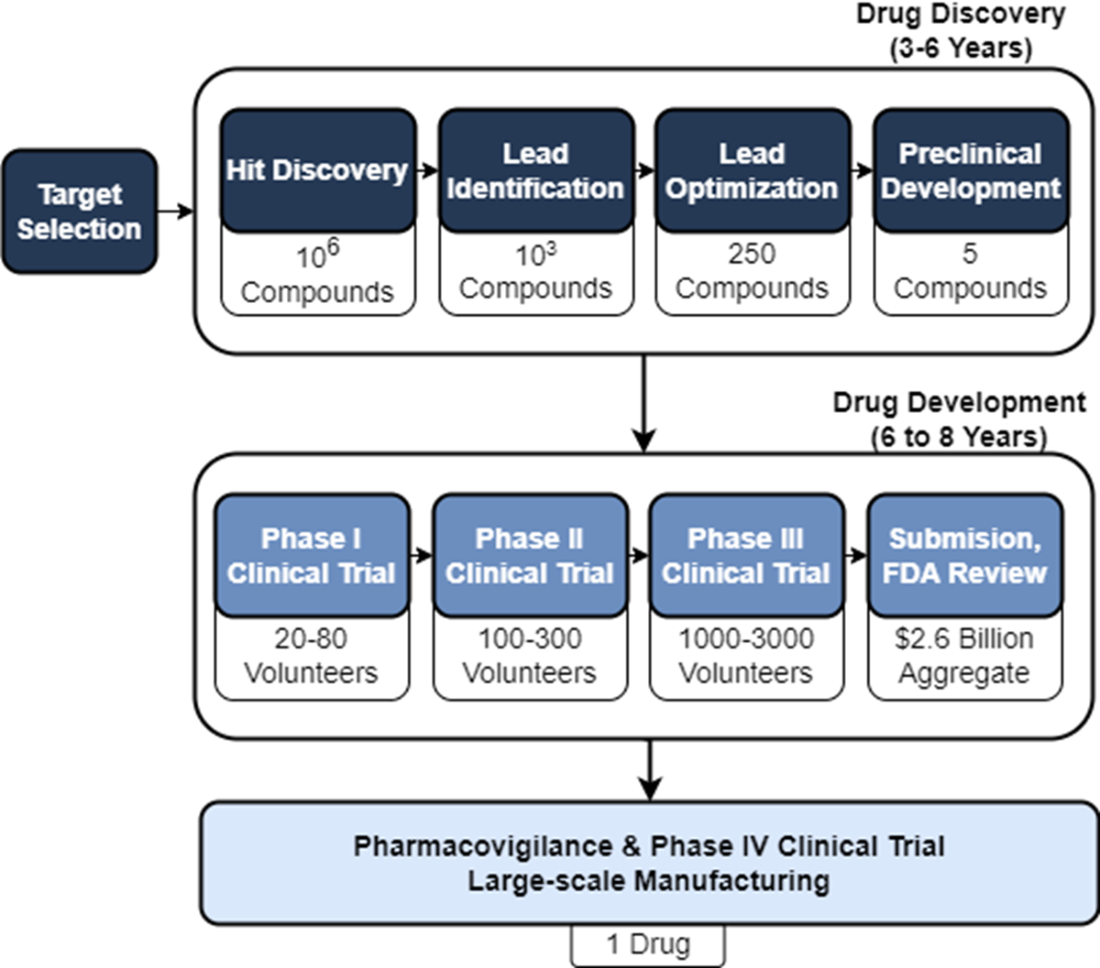
Use the pipeline diagram to distinguish target identification and validation from hit discovery, lead optimization, preclinical development, and later clinical development. section 1.4
