Protein structure is the three-dimensional arrangement of a protein’s atoms and chains. Proteins are built from amino acids linked in a sequence. Their side chains differ chemically, and interactions among them help guide folding. The resulting shape is critical to function and can help explain disease-related changes. section 1.3.4 section 12.1.1
Protein structure can be described at four levels:
- Primary structure: the linear amino-acid sequence. section 12.1.1
- Secondary structure: local backbone geometry, chiefly alpha-helices and beta-strands, stabilized largely by backbone hydrogen bonding. section 12.1.1
- Tertiary structure: the full three-dimensional arrangement of a single chain, including how its local structures and loops pack together. section 12.1.1
- Quaternary structure: an assembly of more than one chain. section 12.1.1
Figure 12.3 Primary structure is the linear sequence of amino acids. Secondary structure is local backbone geometry—chiefly alpha-helices and beta-strands—stabilized largely by backbone hydrogen bonding. Tertiary structure is the full three-dimensional arrangement of a single polypeptide chain, including how its secondary-structure elements and connecting loops pack together. Quaternary structure describes an assembly of more than one chain.
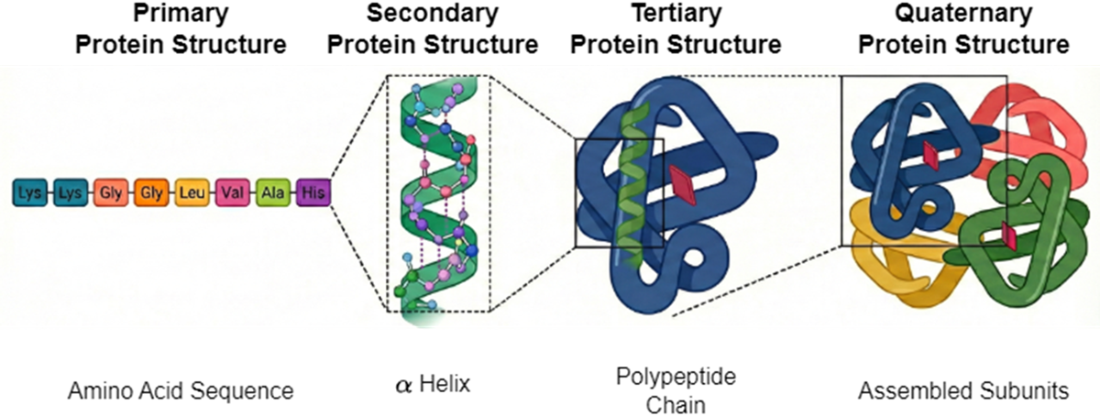
Compare the four levels, from an amino-acid sequence to an assembly of chains. section 12.1.1
A binding pocket
An enzyme’s active site is a binding pocket that recognizes specific molecules. It exists because parts of the amino-acid sequence that are far apart fold together in space. Changes in a target protein’s shape can therefore matter when investigating resistance to cancer treatment. section 12.1.1 section 12.0
A protein is not necessarily rigid. It can explore a range of conformations, or shapes; some proteins or regions remain highly flexible. This matters for protein-ligand docking, because the protein can move as it interacts with a small molecule. section 9.1.1
Structure can be determined experimentally or predicted from sequence. For example, X-ray crystallography uses diffraction data to infer an electron-density map, into which an atomic model is fitted and refined. AlphaFold2 uses deep learning to predict structures, helping address the gap between available sequences and known structures. A prediction is usually a static snapshot: molecular dynamics simulations can complement it by modeling motion over time. section 9.1.1 section 1.3.4
