ESMFold predicts a protein’s three-dimensional coordinates directly from its amino acid sequence. It combines ESM-2, a protein language model, with a separately trained structure-prediction head. ESM-2 turns the sequence into embeddings: numerical representations that carry structural and evolutionary information. The head converts those representations into a predicted structure. section 12.3.5 section 13.3.2
Unlike AlphaFold2, ESMFold does not generate a multiple sequence alignment (MSA): an alignment of related protein sequences obtained by searching sequence databases. Skipping that search makes prediction roughly 60 times faster than AlphaFold2 in the reported comparison, enabling large-scale predictions. The ESM Metagenomic Atlas used this capability to predict over 617 million structures from metagenomic sequences. section 12.3.5
Virtual screening against FADS1
When a high-resolution experimental structure of FADS1 was unavailable, a virtual-screening workflow used ESM-2 embeddings and ESMFold to create docking targets. It generated 20 structural variants by perturbing prediction and clustering the results for diversity. Compounds were screened against the ensemble because a ligand may bind a different conformation from the predicted lowest-energy structure. section 13.3.2
Figure 13.8 Computational funnel architecture for billion-scale virtual screening with progressive accuracy-cost tradeoffs. Receptor.AI's FADS1 inhibitor discovery workflow reduces 4.3 billion candidates through four cascading filters with increasingly stringent evaluation: embedding-based screening (430:1 reduction ratio), parallel structure-based docking across 20 protein conformers (200:1 reduction), and ADMET profiling (500:1 reduction). The parallel docking layer exemplifies the workflow's computational pragmatism, screening 10M compounds against 20 structural variants (200M total predictions) remains tractable with DiffDock's 11.3× speedup over traditional methods, while attempting this scale with slower docking algorithms would be prohibitive. This staged architecture demonstrates how the modular AI components sketched in Figure 13.3 materialize into production pipelines that navigate the accuracy-throughput frontier at billion-compound scale.
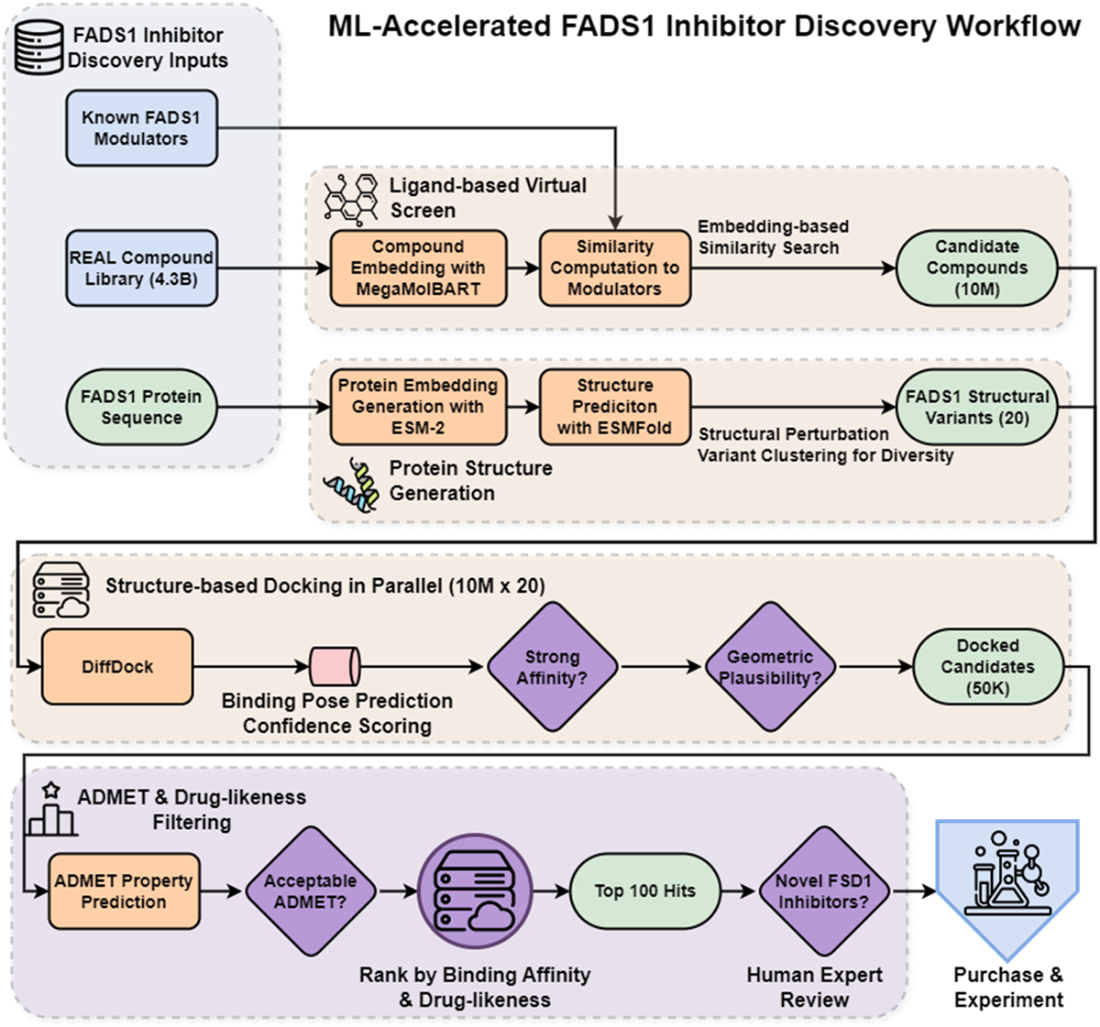
The screening funnel places the 20 predicted FADS1 structures in a larger workflow that filters compounds before and after docking. section 13.3.2
A predicted structure is a hypothesis, not an experimental measurement. Predictions can be less reliable for flexible or disordered regions, multi-chain complexes, membrane proteins, cofactor-dependent sites, and binding pockets that change shape when a ligand binds. Per-residue confidence scores such as pLDDT flag some uncertain regions, but a confident overall fold does not guarantee correct binding-site geometry. section 13.2.1 section 13.3.2
