AlphaFold2 is a deep learning model developed by DeepMind to predict a protein’s three-dimensional structure from its amino acid sequence. Proteins are chains of amino acids; their sequence and interactions between amino acid side chains help determine how they fold. Knowing a protein’s structure can help researchers understand its function and investigate disease. section 1.3.4
Sequence data are much more plentiful than experimentally determined structures. AlphaFold2 helps narrow that gap by predicting structures at high throughput and providing detail that can supplement experiments. Its predictions use multiple-sequence alignment, which compares the target sequence with other protein sequences. section 1.3.4 section 13.2.1
A predicted structure is usually a single static snapshot. Proteins move, so molecular dynamics simulations can complement a prediction by modeling motion over time, including changes involved in binding. A predicted structure can provide a starting point for such a simulation. section 1.3.4
Designing a protein binder
Start with the amino acid sequence of a target protein and predict its structure with AlphaFold2. RFdiffusion uses that structure to design a binder backbone, and ProteinMPNN proposes amino acid sequences for the backbone. AlphaFold2-Multimer then helps assess the resulting protein complexes computationally. section 13.2.1
Figure 13.2 The user provides an amino acid sequence to AlphaFold2, which predicts the target protein structure using multi-sequence alignment as we saw in figure 13.1. RFdiffusion uses the target protein structure to design a protein binder, though it only generates the backbone of the protein binder. RFdiffusion can be steered by the user to explore specific binding interfaces, or hot spot regions of the target protein and identify the most favorable binding configurations according to desired design constraints. Next, ProteinMPNN generates and optimizes amino acid sequences that fit into the RFdiffusion-generated protein backbone, ensuring they exhibit target biochemical properties for effective binding. Finally, AlphaFold2-Multimer is used to validate the interactions and stability of the resulting protein complexes. This integrated approach enables precise and efficient design of protein binders, facilitating advancements in therapeutic protein development and other protein engineering applications.
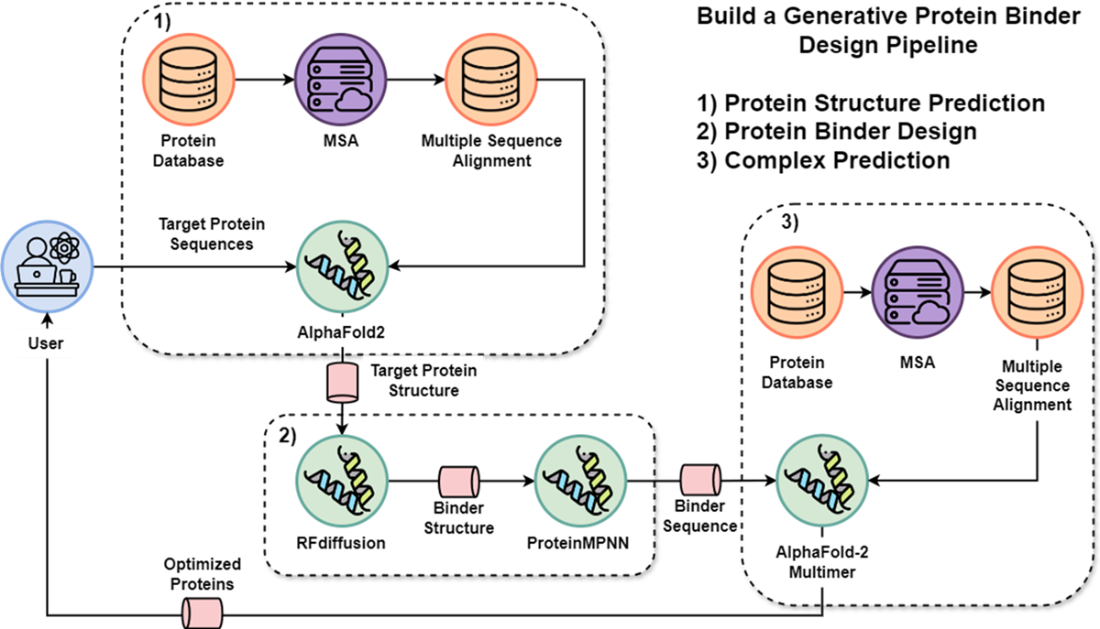
Follow the target structure from AlphaFold2 through binder design, sequence optimization, and complex assessment. section 13.2.1
Structure prediction can also act as a quality gate during therapeutic protein design. AlphaFold2 validation can flag structurally implausible candidates for rejection and regeneration before experimental testing; computational validation does not replace that testing. section 13.3.3
