Protein structure prediction infers a protein’s three-dimensional shape from its amino acid sequence. Knowing that shape helps with structure-based drug design and with investigating how mutations might change a drug target. Experimental structures remain the gold standard, but obtaining them can require substantial time and resources. section 12.0 section 12.1
Prediction is difficult because amino acids far apart in the sequence can interact when the chain folds. Geometry, physical forces, and evolutionary history constrain the resulting shape. The number of possible conformations is enormous, so an exhaustive search is impractical. section 12.1.2
Figure 12.1 Structure prediction (top) takes a sequence and predicts its folded shape. Protein design (bottom) works in reverse, starting with a target shape and finding a sequence that will fold into it. The validation loop shows how prediction models are often used to verify that a designed sequence will actually adopt the intended structure, creating a cycle of design and testing (analogous to the active learning approaches we discussed in chapter 9).
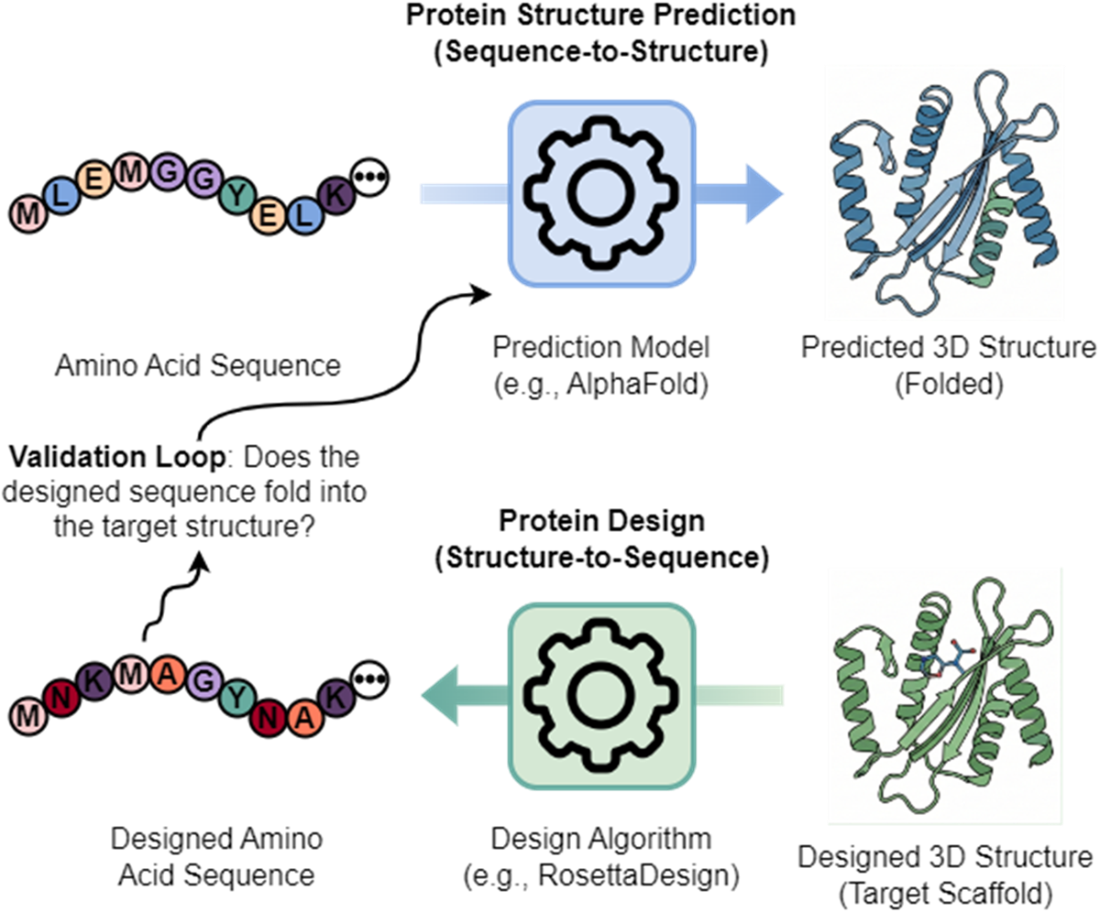
Compare the forward prediction problem with protein design, which starts from a desired shape and seeks a sequence. Predictions can also help test whether a designed sequence may adopt that shape. section 12.1
SimpleFold workflow
SimpleFold starts with an amino acid sequence and uses the pretrained ESM-2 protein language model to produce an embedding for each residue. A generative flow-matching model then iteratively guides noise toward a protein structure. The output is all-atom 3D coordinates and a confidence estimate for each residue; a multiple sequence alignment is not required. section 12.2 section 12.4
Evaluate predicted structures with accuracy metrics on held-out targets, such as CAMEO or CASP sets. Pay particular attention to targets with little evolutionary signal: accuracy can drop for orphan and designed proteins and for some antibody loops. Low-confidence regions should not be trusted. section 12.2
