An amino acid sequence is the linear order of residues in a protein chain, also called its primary structure. Adjacent amino acids are linked by peptide bonds. Their order and the interactions between their side chains help guide folding into a three-dimensional structure, which is important for protein function. section 1.3.4 section 11.3
A sequence as a string
A computational model can represent part of a protein as “MKVLWAALLVTFLAGCQAKV...”. Each letter stands for one of the 20 standard amino acids; the letters appear in the order of the chain. section 12.1.1 section 11.3
The sequence contains information used to specify a protein’s shape, but it does not explicitly list the three-dimensional positions of its residues. Residues far apart in the string can come together as the chain folds, forming features such as an enzyme’s binding pocket. Predicting those contacts requires reasoning beyond local sequence patterns. section 11.3 section 12.1.1 section 12.1.2
Sequences support several practical modeling tasks:
- Structure prediction asks what three-dimensional shape a given sequence will adopt. Protein design reverses the question: which sequence will fold into a desired structure? section 12.1.2
- For drug-target affinity prediction, a protein can be represented as a graph with residues as nodes and spatial contacts as edges. When a structure is available, contacts can be defined using a distance cutoff between residues’ alpha-carbons. section 11.3
- Predicted structures can help address the gap between available sequences and experimentally determined structures, but prediction accuracy varies and experimental validation remains important. section 12.0
Figure 11.4 The Protein Preprocessing and Feature Generation Pipeline. The process begins with a single protein sequence. A multiple sequence alignment (MSA) is generated with HHblits and subsequently filtered by HHfilter. The pipeline then splits into two parallel branches: (1) the filtered MSA is fed into Pconsc4 to predict a contact map, which will define the protein graph's edges, and (2) the MSA is used to calculate a Position-Specific Scoring Matrix (PSSM), which serves as a primary feature for the graph's nodes. All three of these feature computation branches can occur in parallel after sequence preprocessing via HHbilts and HHfilter. Once ready, the contact map, PSSM, and other protein features are combined to construct the full protein graph, which is then processed in aggregate by a GNN to generate the final protein representation. The feature vectors are represented at 3 features to 1 cell ratio.
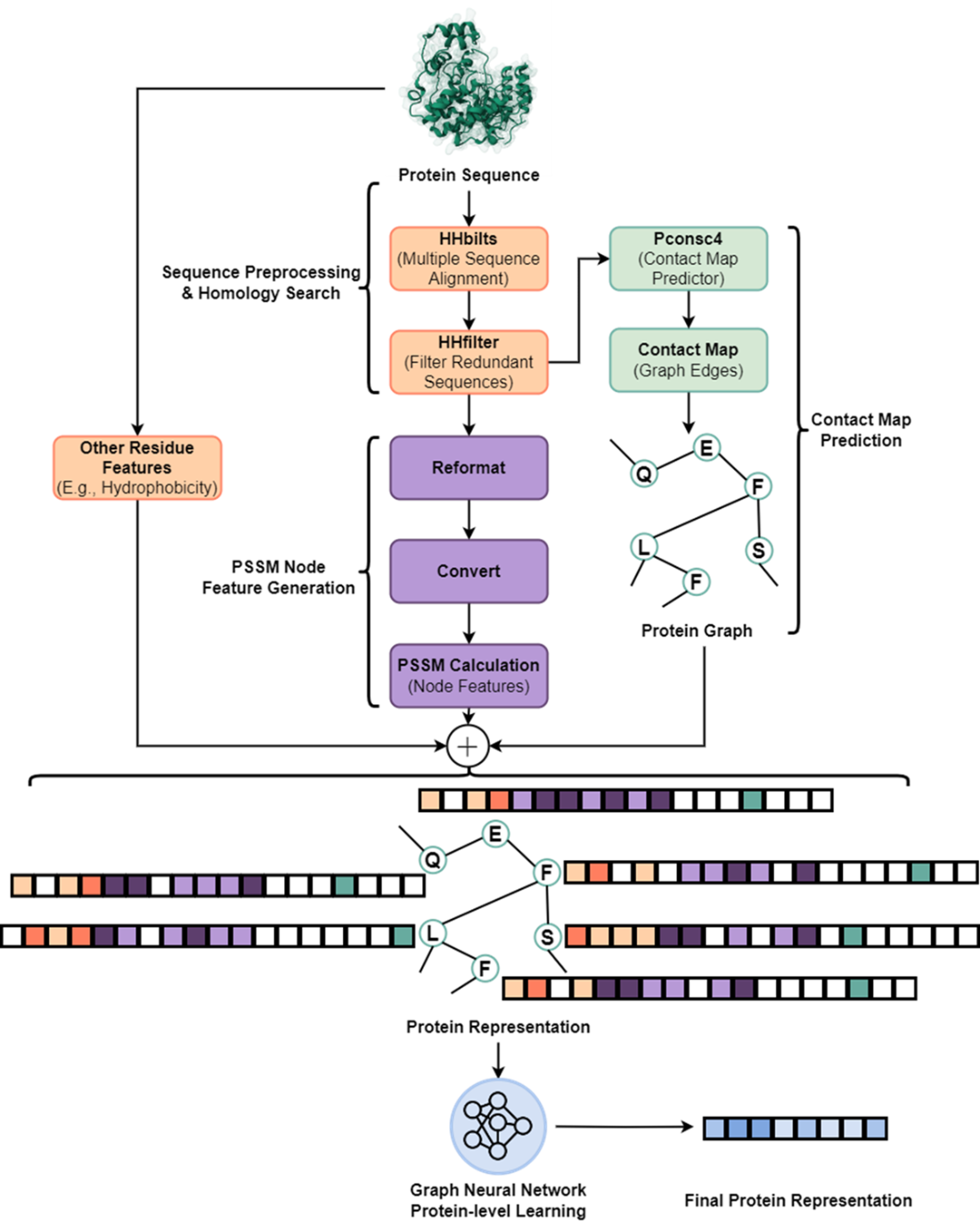
Follow a sequence through alignment and feature generation to a residue graph for a graph neural network. section 11.3
