Protein design is the inverse of protein structure prediction: instead of predicting the three-dimensional structure produced by an amino acid sequence, it seeks a sequence that will fold into a desired structure. The goal is to engineer proteins with custom functions, including new therapeutics. section 12.1 section 12.1.2
A practical design-and-validation workflow connects two complementary modeling problems:
- Specify a target three-dimensional protein structure or desired functional objective. section 12.1
- Search for amino acid sequences likely to adopt the target structure rather than enumerating every possible sequence. section 12.1.2
- Use structure-prediction models to test whether candidate sequences are likely to fold as intended, then iterate between design and testing. section 12.1
The difficulty is global rather than merely local. Amino acids far apart in sequence interact through geometry, physics, and evolutionary constraints, while both conformational and sequence spaces grow astronomically. Successful approaches therefore require reasoning across the entire sequence and exploiting patterns that narrow the search. section 12.1.2 section 12.1
Designing a therapeutic protein
A researcher begins with a three-dimensional structure associated with a desired therapeutic function, proposes amino acid sequences for that shape, and uses a prediction model to check whether the candidates are structurally plausible. Candidates that fail validation can be redesigned, forming a repeated design-and-testing cycle. section 12.1
Figure 12.1 Structure prediction (top) takes a sequence and predicts its folded shape. Protein design (bottom) works in reverse, starting with a target shape and finding a sequence that will fold into it. The validation loop shows how prediction models are often used to verify that a designed sequence will actually adopt the intended structure, creating a cycle of design and testing (analogous to the active learning approaches we discussed in chapter 9).
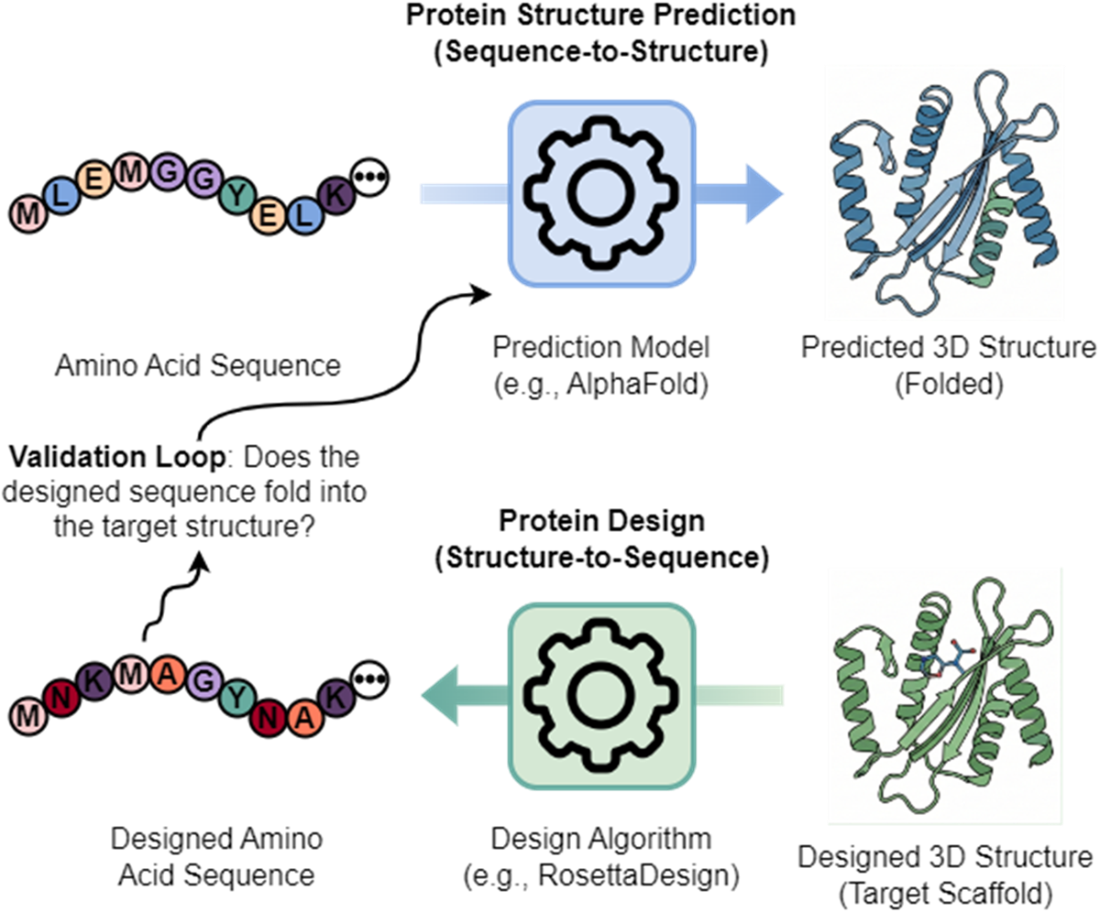
Trace the contrast between forward structure prediction and reverse protein design, including the validation loop that tests designed sequences. section 12.1
