Protein folding is the process by which a chain of amino acids adopts a three-dimensional shape. The protein folding problem asks how to predict that shape from the amino acid sequence. Shape matters because it helps determine what a protein does, including how it binds other molecules. section 1.3.4 section 12.1.1
A protein’s sequence is its primary structure: a string drawn from 20 standard amino acids. Each amino acid has a common core and a distinctive side chain. Attractive and repulsive interactions among side chains help guide the folded structure; amino acids far apart in the sequence can end up close together in space. section 1.3.4 section 12.1.1
Figure 12.3 Primary structure is the linear sequence of amino acids. Secondary structure is local backbone geometry—chiefly alpha-helices and beta-strands—stabilized largely by backbone hydrogen bonding. Tertiary structure is the full three-dimensional arrangement of a single polypeptide chain, including how its secondary-structure elements and connecting loops pack together. Quaternary structure describes an assembly of more than one chain.
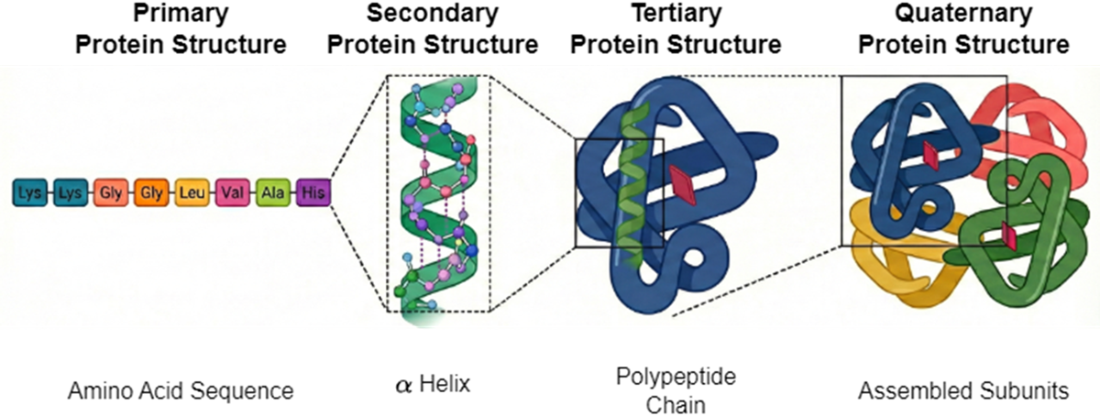
The four levels of protein structure connect the input sequence to local shapes, the full chain, and assemblies of multiple chains. section 12.1.1
Why shape matters for drug discovery
An enzyme’s active site forms when distant parts of its amino acid sequence fold together. Understanding a target protein’s shape can also help researchers investigate how mutations contribute to treatment resistance. section 12.1.1 section 12.0
Prediction is hard because structure depends on long-range interactions as well as geometry, physics, and evolutionary history. For a chain of 100 amino acids, even restricting each of two backbone angles per residue to three choices gives about 2.7 × 10^95 possible conformations. Proteins nevertheless fold far faster than a random search would allow: favorable interactions guide pathways that progressively narrow the possibilities. section 12.1.2
Figure 12.4 The protein folding energy landscape funnel transitions from high-energy unfolded states to the low-energy native state, with decreasing entropy and conformational freedom.
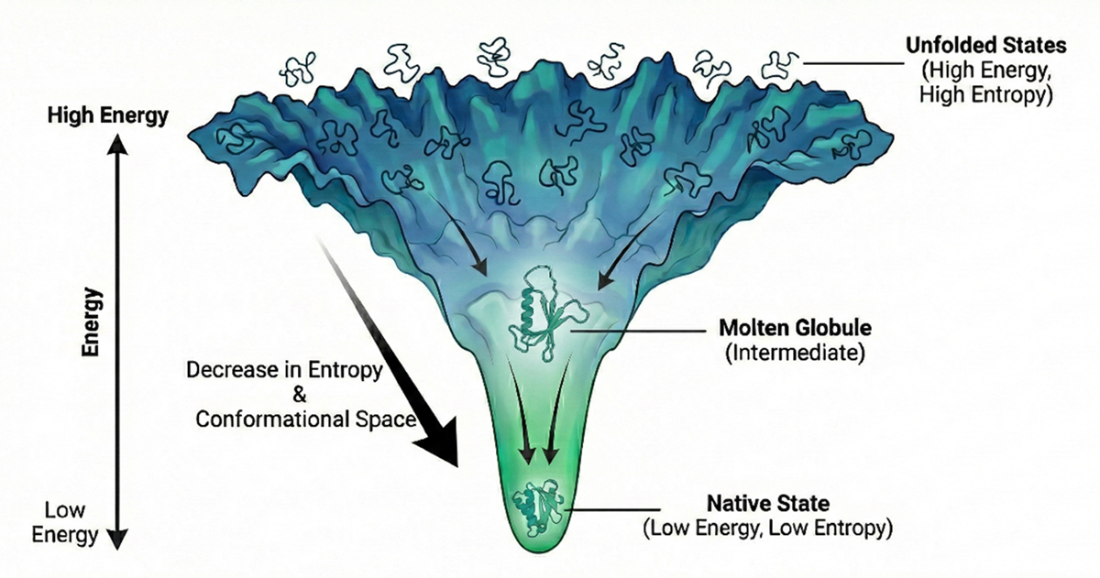
The energy landscape depicts folding as a progression from many high-energy unfolded states toward a lower-energy native state. section 12.1.2
The forward problem predicts a structure from a sequence; the inverse problem, protein design, seeks a sequence that will adopt a desired structure. Deep learning systems such as AlphaFold2 and SimpleFold address structure prediction. They help narrow the gap between the large number of known sequences and the smaller number of experimentally determined structures, while supplementing experimental methods. section 12.1.2 section 1.3.4 section 12.1.1
A predicted structure is usually one static snapshot, while proteins move. Molecular dynamics simulations complement prediction by modeling motion over time, including changes relevant to binding. Experimental determination remains a gold standard, although methods such as X-ray crystallography can be slow and resource-intensive. section 1.3.4 section 12.0
