Levinthal's paradox asks how proteins reach their native three-dimensional structures so quickly if folding required trying every possible conformation. A 100-residue protein already has roughly 2.7 × 10^95 simplified backbone conformations; sampling one per picosecond would take about 10^76 years, yet real proteins fold in microseconds to seconds. section 12.1.2
The resolution is that folding is not blind random search. Favorable interactions form early and progressively narrow the conformational space, guiding the chain toward lower-free-energy states. This energy-landscape view also frames drug discovery: flexible proteins and molecules must find favorable arrangements without exhaustively searching chemical and biological possibilities. section 12.1.2 section 1.1.1
From protein folding to drug discovery
A target protein may adopt many conformations, while a candidate molecule samples its own. Binding occurs when both adjust toward an arrangement that lowers the system's free energy. This motivates computational methods that prioritize promising candidates instead of testing an impossible number of molecules experimentally. section 1.1.1
Figure 12.4 The protein folding energy landscape funnel transitions from high-energy unfolded states to the low-energy native state, with decreasing entropy and conformational freedom.
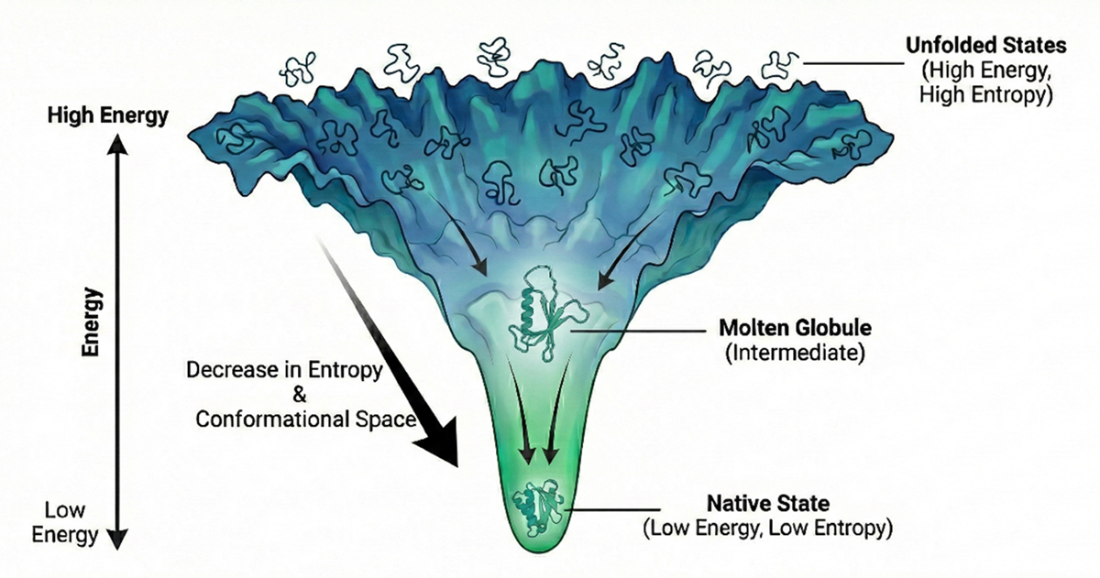
Use the energy-landscape funnel to visualize movement from many high-energy, unfolded states toward a low-energy native state with less conformational freedom. section 12.1.2
