Root-mean-square deviation (RMSD) summarizes the average positional difference between corresponding atoms in two molecular structures. In molecular docking, it compares a predicted binding pose with a crystallographic pose; smaller values indicate closer geometric agreement. section 13.2.2
Interpret RMSD in a pose-comparison workflow:
- Compare corresponding atoms after aligning the molecular structures. section 13.2.2
- Use symmetry-corrected heavy-atom RMSD when equivalent atom arrangements could otherwise distort the comparison. section 13.2.2
- Treat RMSD as a geometric pose-recovery measure, not as a potency or affinity estimate. section 13.2.2
Rentosertib pose recovery
A predicted rentosertib pose overlaid on the TNIK co-crystal structure PDB 8ZML produced 0.92 Å symmetry-corrected heavy-atom RMSD. Four independent runs returned 0.92, 0.81, 0.85, and 0.70 Å. section 13.2.2
Figure 13.5 The rank-1 DiffDock pose of rentosertib overlaid on its crystallographic pose in the TNIK ATP site (PDB 8ZML), at 0.92 Ångströms symmetry-corrected heavy-atom RMSD. The hinge contacts that define the binding mode, the Met105 gatekeeper and the Cys108 hinge residue, are reproduced, and the rank-1 pose is also the best of the 20 sampled, so the confidence ranking selected the right one rather than merely including it. Four independent runs returned 0.92, 0.81, 0.85, and 0.70 Å. Note this is pose recovery rather than blind prediction, as 8ZML is a rentosertib co-crystal in the PDB and the served weights are trained on PDB-derived data, so the complex may sit inside the model's training distribution.
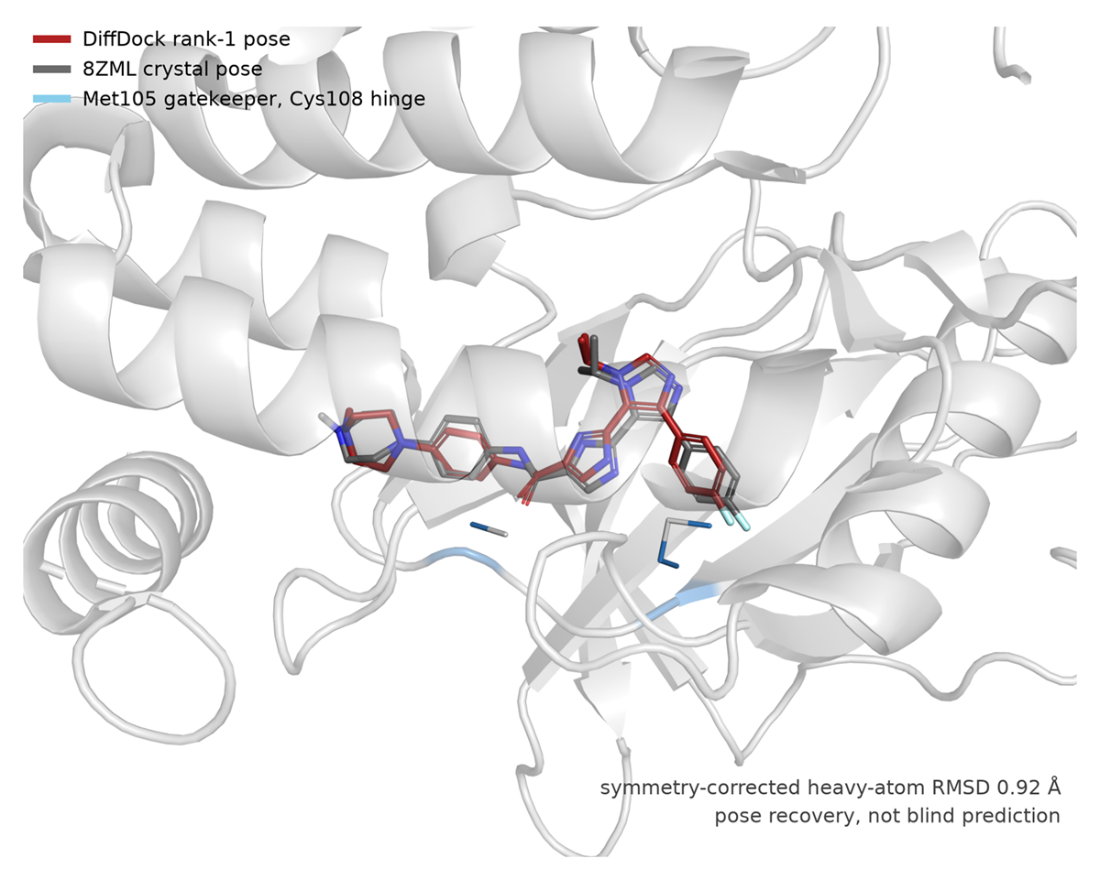
Inspect the pose overlay, reproduced hinge contacts, sampled-pose ranking, and training-distribution caveat. section 13.2.2
