Molecular dynamics (MD) simulates how atoms and molecules move over time by integrating the physical forces between them. For proteins, it replaces a single static structure with a moving view of molecular behavior. section 1.3.4 section 12.1.2
A predicted protein structure is only a snapshot. MD can reveal conformational ensembles, induced-fit binding events, and allosteric changes that static structures cannot capture. section 1.3.4
MD contributes to protein-structure and drug-discovery workflows by:
- Showing how predicted structures move and bind rather than treating them as fixed objects. section 1.3.4
- Modeling every atom through Newton’s equations of motion to explore protein conformations. section 12.1.2
- Providing a physics-based approach whose timescale limits make complete folding simulations impractical for most proteins. section 12.1.2
From a static structure to molecular motion
A predicted protein structure can serve as an MD starting point; the simulation then shows how that structure changes over time and how binding or allostery may emerge. section 1.3.4
Figure 12.4 The protein folding energy landscape funnel transitions from high-energy unfolded states to the low-energy native state, with decreasing entropy and conformational freedom.
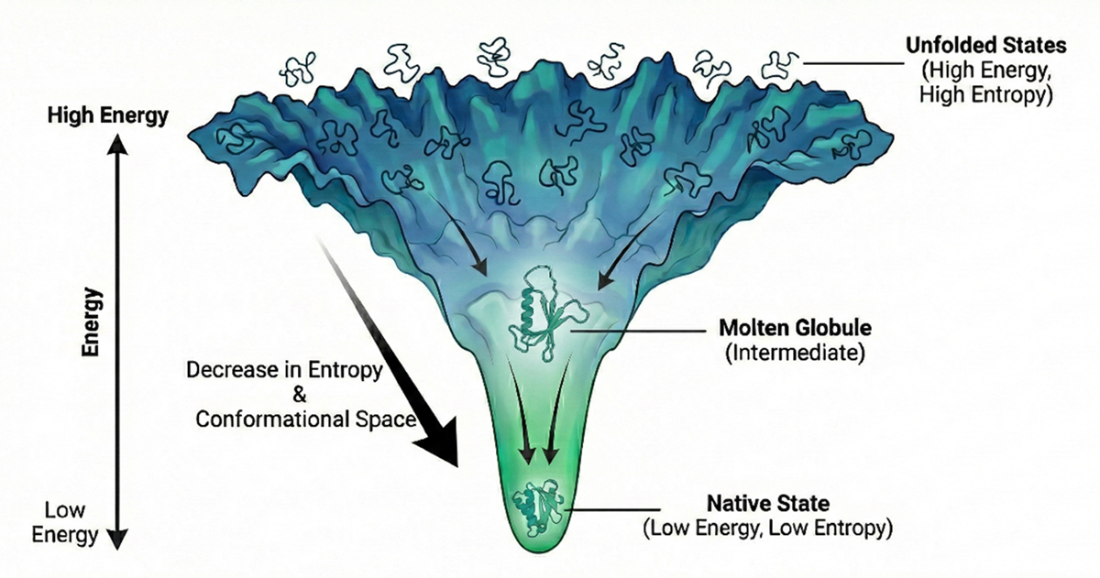
Use the energy-landscape funnel to place MD within the broader problem of exploring high-energy, unfolded, and low-energy protein conformations. section 12.1.2
