The biological search space is the set of biological targets and relevant variants that candidate molecules might bind and influence. Targets include proteins, DNA, RNA, lipids, and carbohydrates. Around 20,000 protein-coding genes can expand through alternative splicing, post-translational modifications, and sequence variation into hundreds of thousands or more proteoforms. section 1.1.1
Drug discovery intersects this biological space with the chemical search space:
- Target selection is usually narrower than testing every molecule against every protein, but the chosen target may have many relevant variants. section 1.1.1
- Targets are flexible rather than rigid: proteins occupy multiple three-dimensional conformations, and candidate molecules sample conformations too. section 1.1.1
- Binding affinity describes the strength of the association formed when molecule and target adjust toward a lower-free-energy arrangement. section 1.1.1
Finding a candidate for one target
A discovery team may already know which target it wants to influence. It then searches for a suitable molecule while accounting for the target’s flexible and only partly known conformational states, rather than examining every possible molecule–protein pairing. section 1.1.1
Figure 1.1 Drug discovery can be thought of as a difficult search problem that exists at the intersection of the chemical search space of 1063 drug-like compounds and the biological search space of 105 targets.
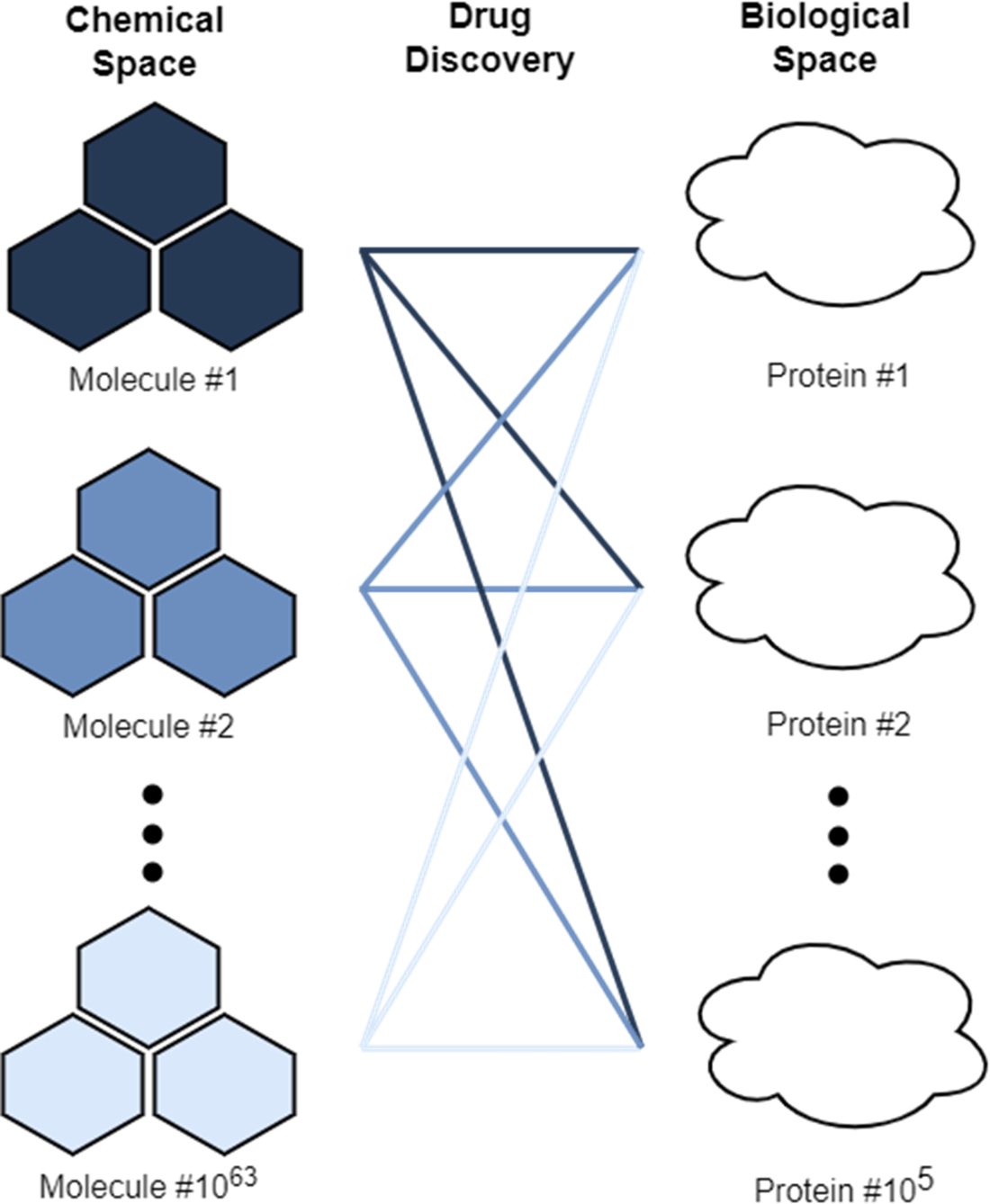
Visualizes drug discovery as the intersection of enormous chemical and biological search spaces. section 1.1 section 1.1.1
