liveBook · Manning

Blast radius

As explained in Platform Engineering on Kubernetes

Blast radius is the extent of systems, resources, or users that can be affected by a failure or security compromise.

Blast radius measures how many services may be affected when a security breach occurs. In distributed systems, unrestricted service-to-service invocation can expose the entire system. section 7.1.2

Reduce blast radius by enforcing system-level interaction rules:

  • Assign service identities. section 7.1.2
  • Allow only explicitly permitted service-to-service calls. section 7.1.2
  • Restrict the protocols and ports used for communication. section 7.1.2
  • Delegate rule validation to an external mechanism rather than duplicating it inside every service. section 7.1.2

Service A and Service B

If Service A is allowed to call only Service B, a compromised surrounding service cannot freely invoke every service, limiting the breach’s reach. section 7.1.2
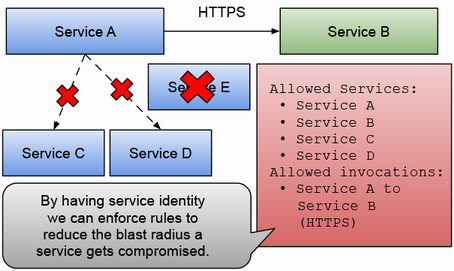
Figure 7.5 Reducing the blast radius by defining system-level rules

Shows how system-level interaction rules reduce the number of services exposed by a compromise. section 7.1.2


How Platform Engineering on Kubernetes covers it

How deep it goes
Defines the metric and explains identity, allowed calls, protocols, ports, and external rule enforcement, without implementation details.
Examples
Uses Service A and Service B, unrestricted invocation, compromised services, and system-level interaction rules.
What it assumes
Assumes familiarity with services communicating across a distributed application.
What you can do after
Apply service identities and interaction rules to restrict calls and reduce the services affected by a compromise.
How it connects
Connects blast radius with service identity, service-to-service communication, authorization, protocols, ports, and distributed applications.

Also explained in

Compare how 4 books explain blast radius →

Related concepts

This explainer was generated by Manning's knowledge graph from the text of Platform Engineering on Kubernetes. The section links point to the parts of the book it draws on.

