A DSL-based approach lets domain experts author precise domain knowledge as DSL content through a Domain IDE. That content serves as a software specification, while developers build the tools and generate much of the Runtime automatically. section 1.2 section 1.5
The approach divides responsibilities across a domain-oriented toolchain:
- Domain experts write and maintain DSL content in a Domain IDE designed around their work rather than general-purpose programming. section 1.2
- The DSL provides a shared language between domain experts and software developers, reducing error-prone translation of business knowledge. section 1.3.4
- The Domain IDE frontend offers a DSL editor; its backend supplies an API, repository, and build system for generating the Runtime. section 1.5
- The DSL defines notation, structure, meaning, and constraints so content can be represented, validated, and turned into behaving software. section 1.5
Car-rental Runtime
In a car-rental business, domain experts can specify concepts such as business rules, conditions, actions, record types, and attributes. Generated software can support both customer rental arrangements and employee point-of-sale processes. section 1.3.4 section 1.2
Figure 1.2 Using a DSL-based approach to develop a Runtime using a Domain IDE
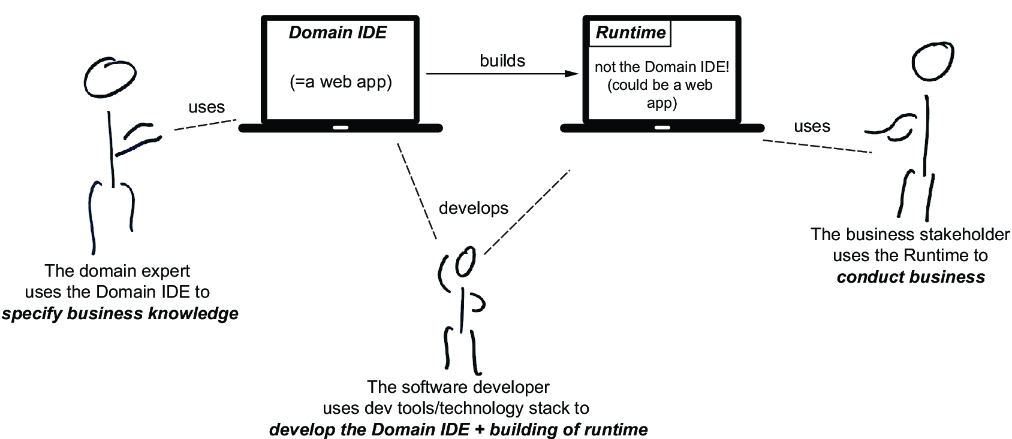
Use the architecture figure to trace how domain experts’ DSL content flows through the Domain IDE into the generated Runtime. section 1.2
