Boosting combines simple, imperfect models into a stronger learner. Instead of training each model independently, it trains them sequentially so each new model improves on mistakes made earlier. The intuition resembles coordinating uncertain amateurs: individually limited, they become effective when their efforts are combined. section 4.0 section 4.1
A boosting ensemble follows this general pattern:
- Start with a weak learner: a simple classifier that performs only slightly better than random guessing. section 4.1
- Train the next learner with dependence on the previous learner, directing it toward earlier mistakes. section 1.5 section 4.1
- Repeat the process and combine the weak learners into one strong learner. section 4.1
- In adaptive boosting, or AdaBoost, reweight examples adaptively so successive learners focus on correcting previous errors. section 1.5 section 4.0
Decision stumps as weak learners
Decision trees are common boosting base estimators, especially decision stumps—trees of depth one. Increasing tree depth can improve the individual classifier, but excessive strength can cause overfitting and reduce deployed prediction performance. section 4.1 section 4.1
Figure 4.1 Differences between parallel and sequential ensembles: (1) base estimators in parallel ensembles are trained independently of each other, while in sequential ensembles, they are trained to improve on the predictions of the previous base estimator; (2) sequential ensembles typically use weak learners as base estimators.
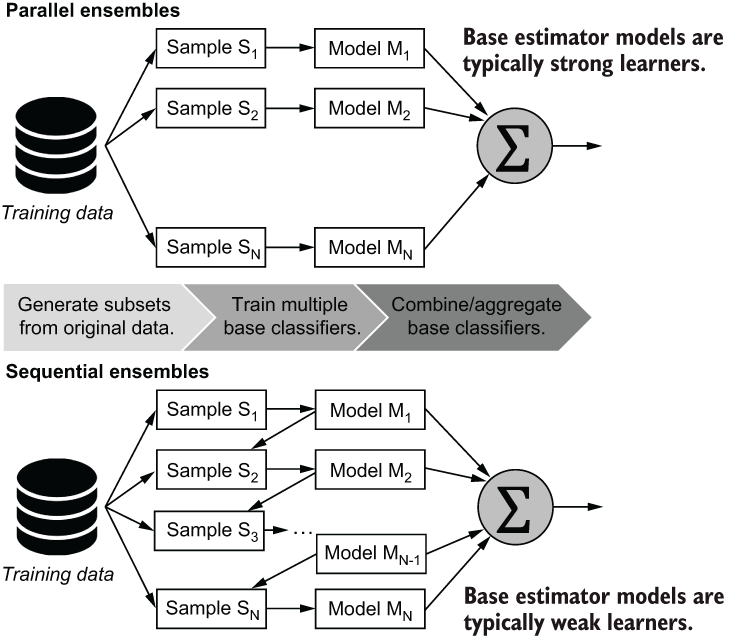
Compare independent training in parallel ensembles with sequential training that improves on previous predictions. section 4.1


