Could several modest models work together to make stronger predictions? Boosting trains weak learners in sequence: each new learner focuses more on examples earlier learners handled poorly, and their predictions combine into a stronger model. section 12.0 section 12.7
A basic boosting process works like this:
- Train an initial learner on the dataset. section 12.1
- Give more attention to examples the learner predicts poorly, then train another learner on the modified data. section 12.1
- Repeat the process and combine learner predictions; boosting can use a weighted vote. section 12.7
Bagging also combines weak learners, but trains them on random data subsets. Boosting instead builds learners strategically, one after another, to address earlier weaknesses. section 12.1
AdaBoost on spam email
AdaBoost is a boosting algorithm for classification and regression. In a spam-classification example, six depth-one decision trees use the number of occurrences of “lottery” and “spam” as features; Scikit-Learn fits the classifier to the labels. section 12.3
Figure 12.1 Ensemble methods consist of joining several weak learners to build a strong learner.
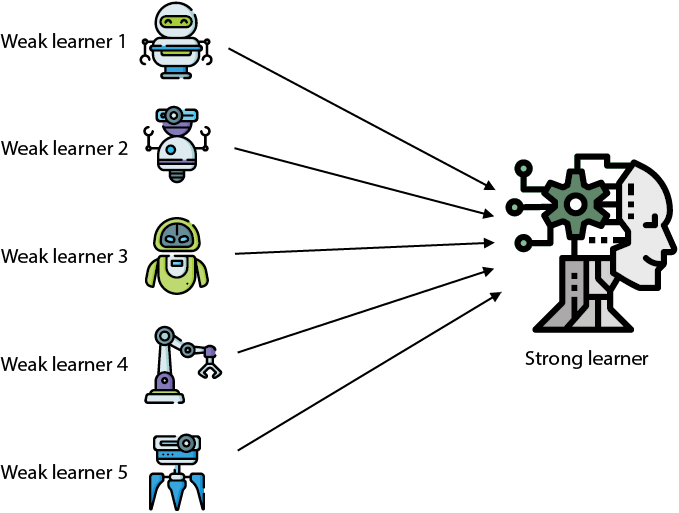
See how weak learners combine to form a strong learner. section 12.1


