The running state means a task has successfully started execution. In the container-oriented lifecycle, a worker reaches this state after starting the task’s container. It follows Scheduled and precedes either normal completion or failure. section 2.1 section 4.6.3
Treat Running as an operational state with explicit transition rules:
- Enter Running when a worker successfully starts a scheduled task. section 4.6.3
- Remain Running when the worker observes the task still executing. section 4.6.3
- Move to Completed when the task finishes normally or is stopped by a user. section 2.1 section 4.6.3
- Move to Failed when the task crashes or the worker cannot start it successfully. section 2.1 section 4.6.3
Representing Running in Go
A Go State enumeration places Running between Scheduled and Completed or Failed. A transition map then records Running as allowing Running, Completed, or Failed, while helper logic checks whether a requested transition is valid. section 4.6.3
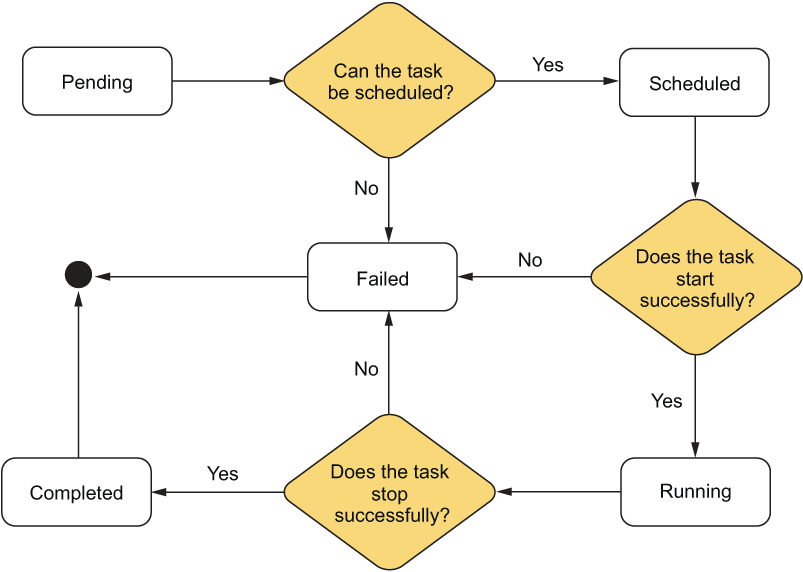
Use the lifecycle diagram to follow Running’s position between scheduling, execution, completion, and failure. section 2.1
