A bot can answer quickly and still make a user’s job harder. Imagine asking for a claim’s status, then spending several turns supplying information the service could reasonably obtain from a login. A useful conversational bot starts with the user’s goal, not just the steps in its own process. It may serve people through chat or voice, answering questions, guiding a transaction, or routing them to help. section 1.1.1 section 3.0
For a question-answering bot, a simple mental model is: user utterance → intent → response. An utterance is what the user says; an intent groups utterances with similar meanings; a response is what the bot returns. “What time are you open?” and “What are your hours?” can therefore lead to the same store-hours answer. In an intent-based bot, the builder controls that answer, though a growing set of intents becomes harder to train and maintain. section 2.1.2
Figure 2.2 Question-answering bots map user utterances to intents, which map to answers.
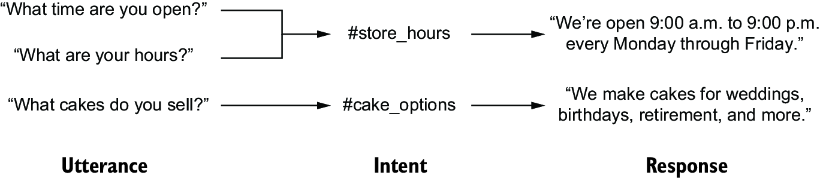
The diagram shows the utterance-to-intent-to-answer path used by a question-answering bot. section 2.1.2
A bot also needs a way to begin and a way to recover when it cannot match a request. A greeting can tell users what help is available. If a request remains unclear, asking for a rephrase once and then offering a human agent is less likely to trap the user than repeating the same prompt. section 2.1.1
Use context to reduce effort
For a claim-status request, a process-oriented bot may ask several questions before providing any value. If the user is identifiable from a login or caller number, a context-aware bot can use that information to reach the likely claim sooner. The assumption should serve the user’s goal rather than force the user through a generic dialogue. section 1.1.1
Judge a bot by what happens after a user asks for help: Does it give an accurate answer, advance a transaction, or route the user appropriately without needless follow-up? Collect real utterances, establish a test baseline, and monitor changes. Generative AI offers another way to form responses, but fluent answers do not remove the need to manage errors and business risk. section 3.0 section 4.6 section 1.0
