A bottleneck layer is the constrained intermediate representation in an autoencoder. It receives compressed output from the encoder and allows only the most important information to pass to the decoder for reconstruction. section 9.4 section 9.5
Use the bottleneck to reason about an autoencoder’s compression and training:
- Set the code size, or number of nodes in the middle layer, to control compression; smaller values create more compressed representations. section 9.5
- Compare decoder output with the original input using reconstruction loss; compression can cause information loss. section 9.4 section 9.7
- Expect useful compression when input variables have relationships or correlations that the encoder can capture. section 9.5
Dimensionality reduction
An undercomplete autoencoder compresses an unlabeled dataset into a bottleneck and reconstructs it. The bottleneck supplies a lower-dimensional representation, while nonlinear layers can learn relationships that PCA cannot. section 9.7
Figure 9.1 Structure of an autoencoder with an encoder, a bottleneck, and a decoder
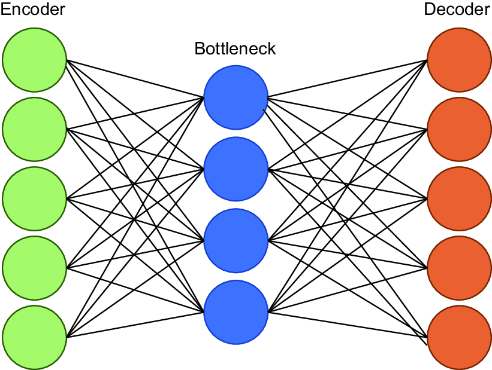
Inspect the encoder–bottleneck–decoder structure as a visual compression and reconstruction pipeline. section 9.4



