A bottleneck layer, also called a bridge, is the lowest point of an encoder-decoder network. It receives the most compressed, abstract image representation before the decoder begins reconstruction. In a U-Net, it connects the downsampling path to the upsampling path and provides a natural place to combine image information with text and timestep guidance. section 12.15 section 12.18
The bottleneck performs three closely related jobs:
- Compresses the image into a generalized description of its core content, emphasizing what the image contains rather than precise pixel locations. section 12.18
- Expands channel capacity when useful: increasing from 8 to 16 channels gives the network a richer vocabulary for representing complex content. section 12.18
- Combines the abstract image representation with text and timestep embeddings before the upsampling path reconstructs spatial detail. section 12.15 section 12.18
A small U-Net bridge
Suppose downsampling produces an 8×4×4 tensor. The bridge convolution changes it to a 16×4×4 tensor, called h2. Text and timestep embeddings are added to form one 16-dimensional vector, reshaped to 16×1×1, and added across the corresponding channels of h2. The result carries both the image’s abstract content and the external guidance needed for reconstruction. section 12.18
Figure 12.39 How the text embedding and timestep embedding are injected
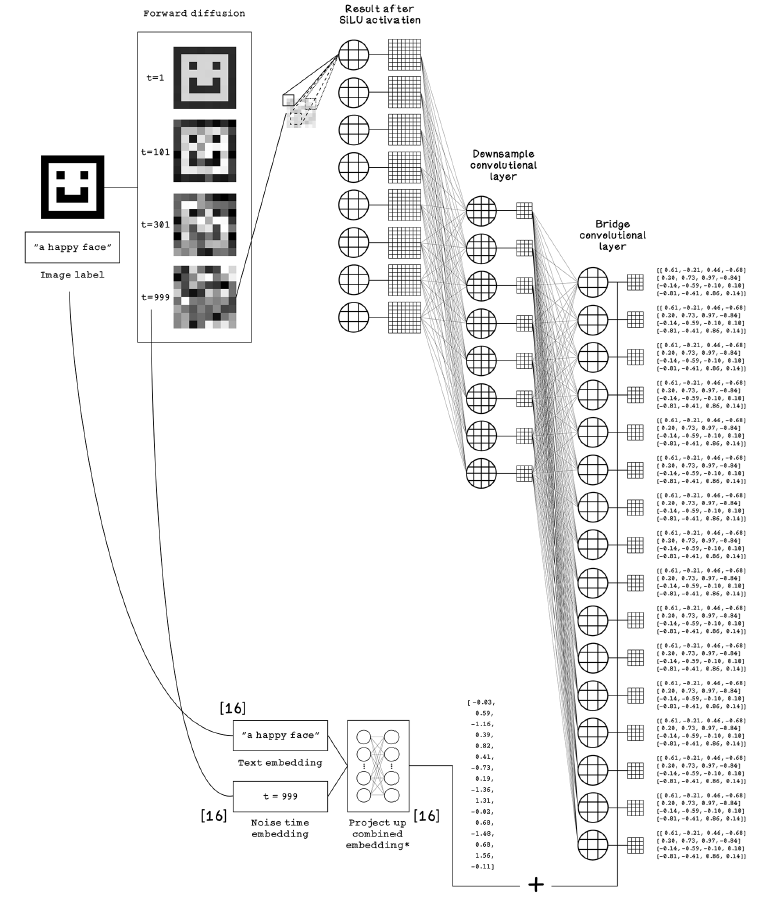
Use the diagram to see how text and timestep embeddings enter the bridge representation. section 12.18



