When a CAD model needs smooth, editable surfaces, boundary representation models only the boundary of the object: contours in 2D and surfaces in 3D. Smooth curve and surface pieces are bounded by their own UV-space boundaries, preserving geometric structure without first converting surfaces into vertices or triangles. section 11.0
A surface described directly by f(u, v) → (x, y, z) is already a boundary-representation surface. This differs from a triangle mesh, which approximates a smooth surface with many triangles. Boundary representation dominates CAD and CAE, while triangle meshes favor fast rendering in games, augmented and virtual reality, and computer-generated imagery. section 11.0 section 11.7
A torus in two representations
A torus can be described as one smooth surface or approximated by a triangle mesh of roughly 10,000 triangles. The smooth form preserves precision; the mesh is more suitable where rendering speed matters. Increasing mesh size improves approximation but increases computational cost and can make operations more failure-prone. section 11.0 section 11.7
Figure 11.1 A torus described as a smooth surface (left) and as a triangle mesh of ~10,000 triangles (right)
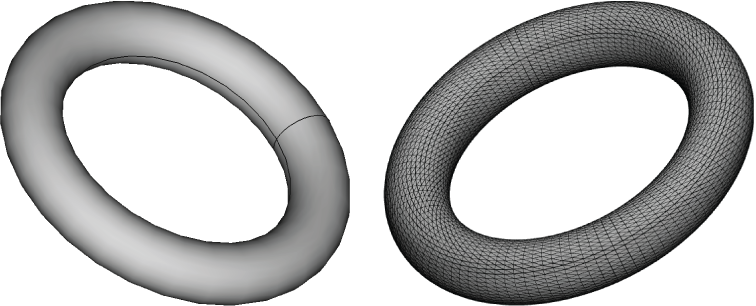
Compare the same torus as a smooth boundary surface and as a triangle mesh. section 11.0
