A bounded context establishes the boundary within which a domain model applies, typically aligning a subsystem’s responsibilities with a business capability and the team shaping it. Precise boundaries reduce unrelated behavior being combined and help teams evolve software independently. section 12.3.1 section 12.5
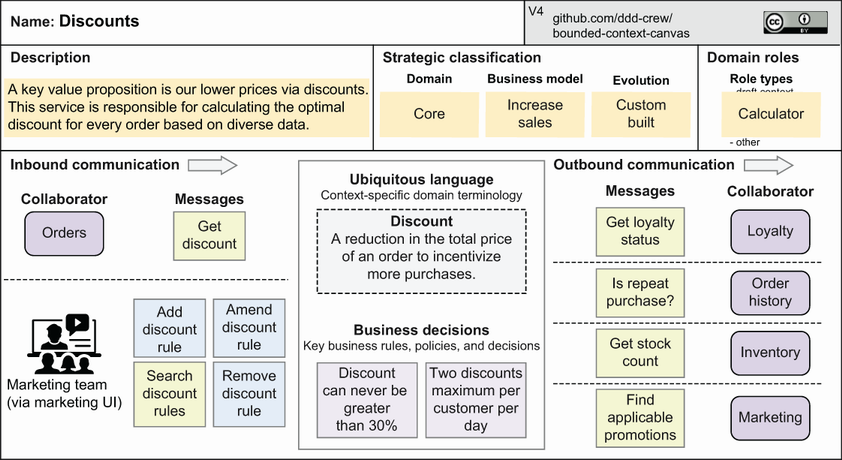
Use the bounded context canvas to make a subsystem’s purpose, responsibilities, business role, and strategic classification visible for collaborative design review. section 12.3.1
A useful bounded context analysis asks:
- What precise name identifies the subsystem, and would a broader name attract unrelated responsibilities? section 12.3.1
- What business purpose and responsibilities does the context contain, and do stakeholders describe them consistently? section 12.3.1
- How does the context support business strategy through its classification, business-model role, and expected evolution? section 12.3.1
Country-specific onboarding on a gigs platform
A platform whose teams owned different domain areas still suffered from shared software coupling. EventStorming helped separate German and Dutch company and contact rules into a new bounded context. The German model was first implemented as a decoupled codebase, while modernization initially retained a shared database; later, domain events and an anti-corruption layer synchronized the legacy model as the new context became autonomous. section 12.5

