Bounds checking
Bounds checking verifies that an index, access, or operation falls within the permitted limits of a data structure, memory region, or range.
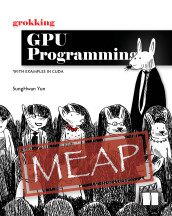
Grokking GPU Programming
A bounds check is a conditional test that verifies an index lies within a data structure's valid range before access or computation.
- How it is used
- Guards CUDA array accesses when thread launches or neighbor offsets can produce indices outside valid data.
- How deep it goes
- Works through guards, failure symptoms, allocation sizing, and synchronization; notes boundary divergence but defers its detailed cost.
- Examples
- Uses a 1,000-element multi-block launch, a scan’s left-edge access, and stencil neighbor checks.
- What you can do after
- Apply bounds checks in CUDA kernels and diagnose crashes or incorrect results caused by missing guards.
Read how Grokking GPU Programming explains bounds checking →
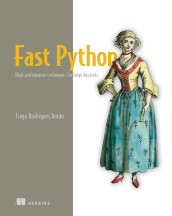
Fast Python: High performance techniques for large datasets
- How it is used
- Uses index guards to prevent invalid memory access in CUDA kernels and discusses bounds-checking overhead in Cython.
- How deep it goes
- Explains the excess-thread failure case and explicit guard, while noting that disabling Cython checks removes a safety net.
- Examples
- Uses a one-dimensional CUDA array with excess threads and a Cython memoryview whose automatic checks can be disabled.
- What you can do after
- Apply an explicit CUDA index guard to prevent excess threads from accessing elements beyond an array’s size.
Read how Fast Python: High performance techniques for large datasets explains bounds checking →

CUDA for LLMs
A boundary check is a conditional test that prevents a computation from accessing data outside its valid range.
- How it is used
- Prevents CUDA threads from accessing data outside valid dimensions when a launch covers more positions than the workload.
- How deep it goes
- Implements guards for vector, matrix, and GEMV kernels without analyzing their performance cost.
- Examples
- Uses vector addition, 1000-by-500 matrix addition, and a GEMV row loop to illustrate guarded accesses.
- What you can do after
- Apply conditional guards in CUDA kernels before accessing elements indexed by thread coordinates.
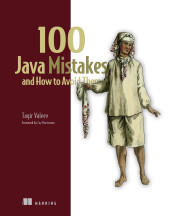
100 Java Mistakes and How to Avoid Them
A bounds check is a validation that an index or indexed range lies within the permitted limits of a data structure.
- How it is used
- Prevents invalid array, string, list, and indexed-range access before it causes exceptions or worse program behavior.
- How deep it goes
- Explains empty inputs, ordering errors, reversed comparisons, off-by-one errors, range constraints, and standard library checks.
- Examples
- Uses empty strings, array element access, offset-count ranges, and custom InputStream and List implementations.
- What you can do after
- Diagnose/debug with it by locating unsafe access order, reversed comparisons, and off-by-one conditions.
Read how 100 Java Mistakes and How to Avoid Them explains bounds checking →
Also covered in
- Writing for Developers: Blogs that get read
- Rust in Action: Systems programming concepts and techniques
- Memory Safe C++In early access (MEAP)
What to know first
- threadA thread is a distinct sequence of execution with its own control flow and state, managed or scheduled by a processor, runtime, or operating system.
- CUDACUDA is NVIDIA’s parallel computing platform and programming model for performing general-purpose computations on NVIDIA GPUs.
- GPU memoryGPU memory is memory available to a graphics processing unit for storing data and state used in graphics or computation.
- arrayAn array is an ordered collection of elements organized in one or more dimensions and accessible by position or index.
Related concepts
- CUDA kernelused by · A CUDA kernel is a function launched on a GPU for execution by multiple threads in parallel.
- out-of-bounds array accessaddresses · An out-of-bounds array access is an operation that reads or writes an element outside the valid range of an array or associated object.
- convolutionused by · Convolution is an operation that applies a filter or kernel across an input, combining values from local neighborhoods to produce output values.
- naive CUDAused by · Naive CUDA is an initial CUDA implementation that lacks important performance optimizations and may use inefficient memory-access patterns.
Questions about bounds checking
What is bounds checking?
Bounds checking verifies that an index, access, or operation falls within the permitted limits of a data structure, memory region, or range.
Which Manning books explain bounds checking?
Grokking GPU Programming, Fast Python: High performance techniques for large datasets, CUDA for LLMs and 100 Java Mistakes and How to Avoid Them.
What should I know before learning bounds checking?
Manning books that teach bounds checking usually introduce thread, CUDA, GPU memory and array first.
What is bounds checking also called?
Bounds checking is also called boundary check or bounds check.
These guides are generated from the text of Manning books by Manning's knowledge graph and link to the sections they draw on. The full books are available on liveBook and at manning.com.