A branch is an edge in a decision tree representing one possible outcome of a node’s test. It connects a decision or chance node to the next node or endpoint. section 10.2 section 6.3
Branches serve different roles in decision-process trees and predictive decision trees:
- In a decision-process tree, branches lead from choices to uncertain events and carry probabilities when they represent chance outcomes. section 10.2
- In a machine-learning tree, branches represent feature-test outcomes and lead toward class labels or regression values at leaf nodes. section 6.0 section 6.3
- Branches determine the route through the tree; interpretation follows the sequence of outcomes back toward the initial decision. section 10.2
Home-loan approval
A tree first tests whether age is 30 or fewer, then tests income. The left branch follows the true age condition, while the right branch follows the false condition; later branches lead to approval or rejection. section 6.3
Figure 6.6 A decision tree demonstrating the home loan approval process based on the applicant’s age and income. The tree is interpreted from top to bottom, starting at the root node and progressing to the leaf nodes. The left branch is followed when conditions are true, and the right branch is followed when conditions are false.
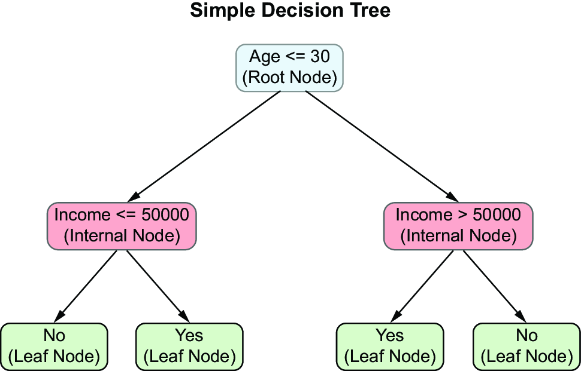
Use the decision-tree figure to trace branches from the root through age and income tests to the approval or rejection leaves. section 6.3





