liveBook · Manning

Broadcast frame

As explained in Acing the CCNA Exam: Volume 1 Fundamentals and Protocols

Broadcast is one-to-all network communication directed to every host on the relevant network segment.

A broadcast frame is addressed to the broadcast MAC address, ffff.ffff.ffff. It sends a message to every host on the relevant LAN, and switches flood it through the segment. section 6.4

ARP uses broadcast frames for requests: a host asks which device owns a specified IP address. The matching host returns a unicast ARP reply. section 6.4

PC1 learns PC3’s MAC address

PC1 broadcasts an ARP request for PC3’s IP address. Switches flood the frame; hosts that do not own the requested IP ignore it. PC3 replies directly to PC1, enabling the original message to use PC3’s MAC address. section 6.4

Figure 6.6 An ARP request and reply exchange between PC1 and PC3. PC1 wants to send a message to PC3 but does not know PC3’s MAC address, so PC1 uses ARP to learn PC3’s MAC address.
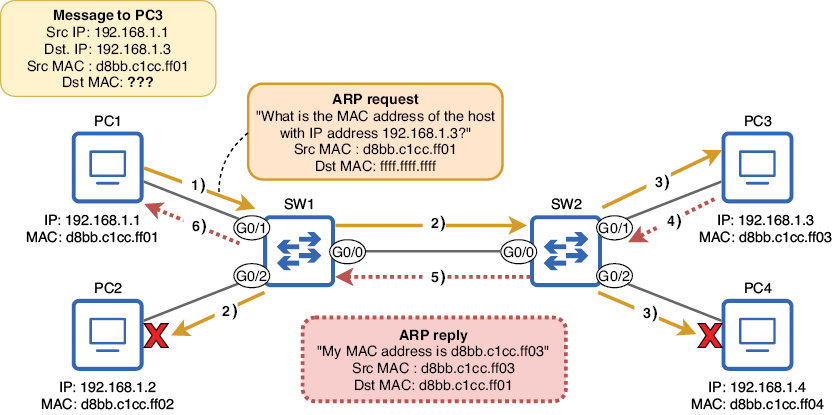
Follow the ARP request and reply across PC1, PC2, PC3, PC4, SW1, and SW2. section 6.4

How Acing the CCNA Exam: Volume 1 Fundamentals and Protocols covers it

How deep it goes
Defines the destination address and flooding behavior, then traces ARP requests and replies across switches and hosts.
Examples
Uses PC1, PC2, PC3, PC4, SW1, SW2, and R1 to demonstrate ARP discovery and frame handling.
What it assumes
Explains broadcast behavior before requiring detailed understanding of IP address structure.
What you can do after
Apply ARP behavior to predict when switches flood frames and when hosts or routers send unicast replies.
How it connects
Connects broadcast frames to ARP, MAC addresses, unicast frames, unknown unicast frames, switches, and ARP tables.

Related concepts

This explainer was generated by Manning's knowledge graph from the text of Acing the CCNA Exam: Volume 1 Fundamentals and Protocols. The section links point to the parts of the book it draws on.