liveBook · Manning

Broadcast network

As explained in Acing the CCNA Exam: Volume 1 Fundamentals and Protocols

A broadcast domain is the set of network devices that receive a broadcast frame sent by a member of the set.

A broadcast domain is the group of network devices that receive a broadcast frame sent by any member. It is roughly equivalent to a LAN or Layer 2 domain: hosts communicate through switches without crossing a router. Broadcast traffic stays within this domain, while a router separates it into different LANs. section 6.4 section 6.1

ARP across switched networks

When PC1 needs PC3’s MAC address, it sends an ARP request to the broadcast MAC address ffff.ffff.ffff. SW1 and SW2 flood the frame, so every device in their shared broadcast domain receives it. PC3 replies, and the switches then forward PC1’s known-unicast data only through the appropriate ports. section 6.4

Figure 6.1 Two offices with two switches in each office. In Office A each switch is a separate LAN because the switches are connected via a router. In Office B both switches are in the same LAN because they are directly connected to each other.
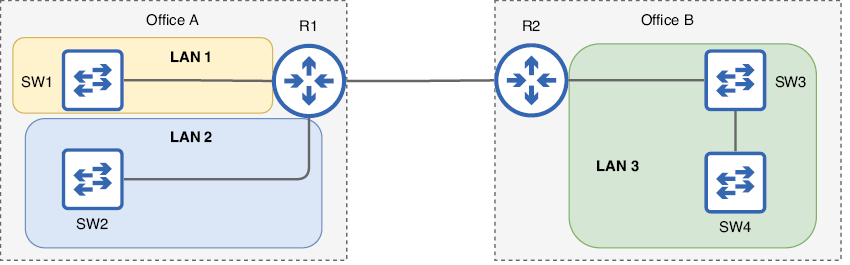
Compare two topologies: directly connected switches form one LAN, while switches connected through a router belong to separate LANs and broadcast domains. section 6.1

How Acing the CCNA Exam: Volume 1 Fundamentals and Protocols covers it

How deep it goes
Explains the definition, router boundary, and ARP flooding behavior, but does not detail broadcast-domain configuration.
Examples
Uses directly connected switches and an ARP request between PCs to demonstrate shared and separated broadcast domains.
What it assumes
Assumes basic familiarity with hosts and switches while defining LANs, Layer 2 domains, broadcast frames, and routers.
What you can do after
Evaluate whether a topology keeps hosts in one broadcast domain by tracing switch paths and router boundaries.
How it connects
Connects broadcast domains with LANs, Layer 2 domains, Ethernet switches, routers, ARP, MAC addresses, unicast, and multicast.

Related concepts

This explainer was generated by Manning's knowledge graph from the text of Acing the CCNA Exam: Volume 1 Fundamentals and Protocols. The section links point to the parts of the book it draws on.