liveBook · Manning

Buffering

As explained in Kafka for Architects

Buffering temporarily stores data between producers and downstream consumers to absorb differences in processing rate or load.

Buffering places an intermediary between producers and downstream consumers. In centralized logging, applications emit events, Fluentd forwards them to Kafka, and Kafka Connect moves them to Elasticsearch. section 5.1.3

A Kafka-based logging path separates event production from indexing:

  • Applications remain independent of the underlying logging system through a generic logging framework. section 5.1.3
  • Fluentd agents collect log files and forward events to Kafka. section 5.1.3
  • Kafka Connect transfers the buffered data to Elasticsearch for centralized search and visualization. section 5.1.3
  • Alternatives include syslog, Logstash, Fluent Bit, direct Elasticsearch integration, and cloud observability platforms. section 5.1.3
Figure 5.7 Sending log data via Kafka to Elasticsearch
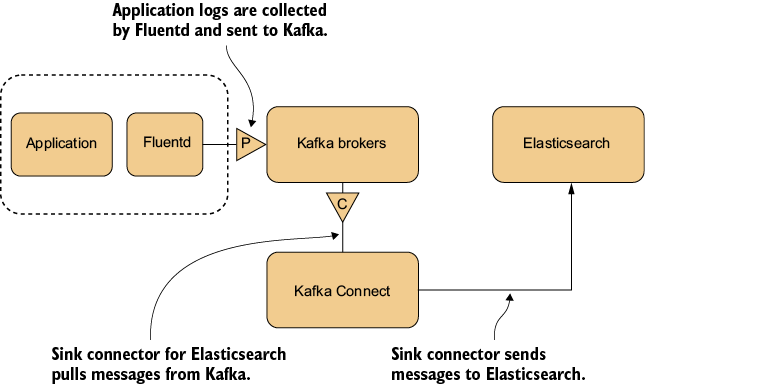
Use the flow diagram to trace log data from collection through Kafka to Elasticsearch. section 5.1.3


How Kafka for Architects covers it

How deep it goes
Explains the log-transfer path and contrasts alternatives, but does not detail buffering internals or configuration.
Examples
Uses application log files, Fluentd agents, Kafka, Kafka Connect, Elasticsearch, and Kibana as the concrete pipeline.
What you can do after
Apply it via a Kafka-based log pipeline or compare it with direct, syslog, and alternative ingestion architectures.
How it connects
Connects buffering with Kafka, Fluentd, Kafka Connect, Elasticsearch, syslog, Logstash, and centralized logging.

Also explained in

Compare how 5 books explain buffering →

Related concepts

This explainer was generated by Manning's knowledge graph from the text of Kafka for Architects. The section links point to the parts of the book it draws on.


