A build system turns precise DSL content into runnable software. It retrieves a serialized abstract syntax tree (AST) from the business-knowledge repository, sends it to a code generator, combines generated code with handwritten code and configuration, and produces a Runtime artifact. section 1.2.2 section 8.5
A build system typically coordinates:
- AST retrieval from the business-knowledge repository. section 8.1
- Code generation for the part of the Runtime that represents domain knowledge. section 8.0
- Combination of generated code, manually written code, and build configuration. section 8.0
- Automatic execution through a Domain IDE button, continuous integration, or a command-line interface. section 8.1
The generator can be developed from a manually implemented reference Runtime. Templates are then parameterized gradually with AST data; JavaScript ES2015 template literals and nested strings support composable, correctly indented generated code. section 8.5
Rental-price Runtime
Business stakeholders specify rental-pricing knowledge in the DSL. The build system generates the corresponding business-logic code and combines it with a web form, handwritten code, and configuration to produce a deployable or runnable Runtime. section 8.0
Figure 8.3 The architecture of the build system and Runtime
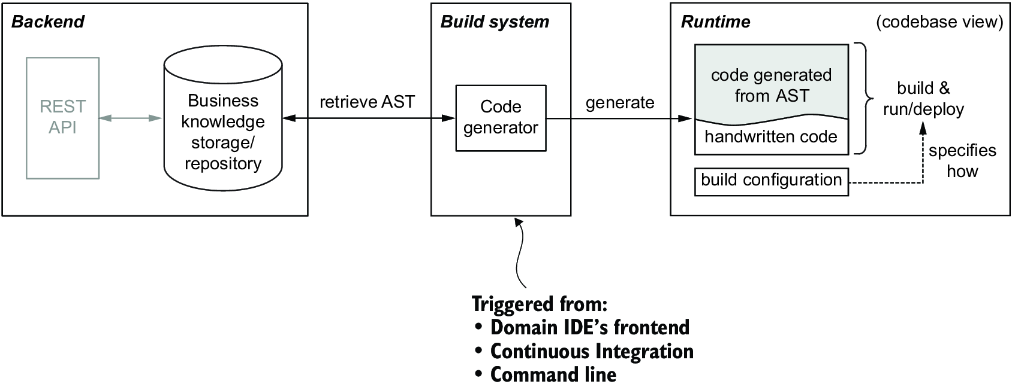
Architecture diagram showing the build system’s relationship to the Domain IDE, AST repository, generated code, handwritten code, and Runtime. section 8.0

