liveBook · Manning

Business analytics

As explained in The Complete Obsolete Guide to Generative AI

The analysis of business data to identify patterns, relationships, and insights that support business decisions.

Business analytics turns raw business data into patterns and insights for decisions. The usual slog is data wrangling—making large datasets consistently machine-readable—followed by algorithms that extract useful findings. LLM workflows aim to reduce the coding and cost burden by letting people query prepared data in plain language. section 8.1

A practical AI-assisted workflow is:

  • Load a dataset, such as an investing-program prediction spreadsheet, and prepare it for retrieval. section 8.1
  • Build an index over the data with an OpenAI API key and LlamaIndex components. section 8.1
  • Ask focused questions, such as which five regions have the highest average household net wealth. section 8.1
  • Use business attributes to identify customers likely to invest in a new offering, returning only customer IDs. section 8.1
Figure 8.1 Using data analytics to derive insights from raw data
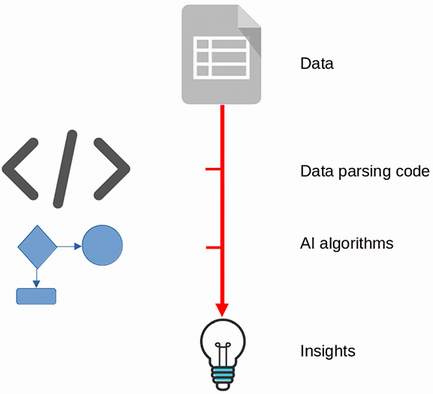
The diagram situates analytics as a path from raw data to usable insights. section 8.1

How The Complete Obsolete Guide to Generative AI covers it

How deep it goes
Defines data wrangling and demonstrates indexing plus natural-language queries, without detailing the underlying analytics algorithms.
Examples
Uses a 90-minute call transcript, an investing-program dataset, regional wealth rankings, and customer-investment predictions.
What you can do after
Apply it via OpenAI and LlamaIndex to index a dataset and issue focused business-data queries.
How it connects
Connects business analytics with data wrangling, large language models, OpenAI Whisper, ChatPDF, Kaggle, and LlamaIndex.

Related concepts

This explainer was generated by Manning's knowledge graph from the text of The Complete Obsolete Guide to Generative AI. The section links point to the parts of the book it draws on.