Business impact analysis (BIA) is a systematic assessment of critical business functions. It estimates how disruption would affect operations and establishes recovery priorities so essential services can continue during and after an incident. section 6.2 section 6.6
Measure each critical process with four recovery targets:
- Recovery Point Objective (RPO) identifies how much data loss, measured in time, is acceptable; a 60-minute RPO requires recovery to a point no older than 60 minutes. section 6.2
- Recovery Time Objective (RTO) sets the acceptable time for restoring a business function, such as restoring email within four hours. section 6.2
- Work Recovery Time (WRT) covers the additional time needed to verify data, test applications, and return operations to normal after systems are restored. section 6.2
- Maximum Tolerable Downtime (MTD) is the longest survivable disruption; it equals RTO plus WRT and precedes potentially severe financial, legal, or reputational damage. section 6.2
Comparing business functions
A prioritization table can compare dependencies and customer, finance, legal, and human-resources impacts. For example, manufacturing may rank first with 27 dependencies, extreme finance impact, and 24-hour RPO, RTO, and 72-hour MTD targets; quality control may rank second, and regulatory compliance third. section 6.2
Figure 6.1 Meaning of key metrics used in business impact analysis with respect to time
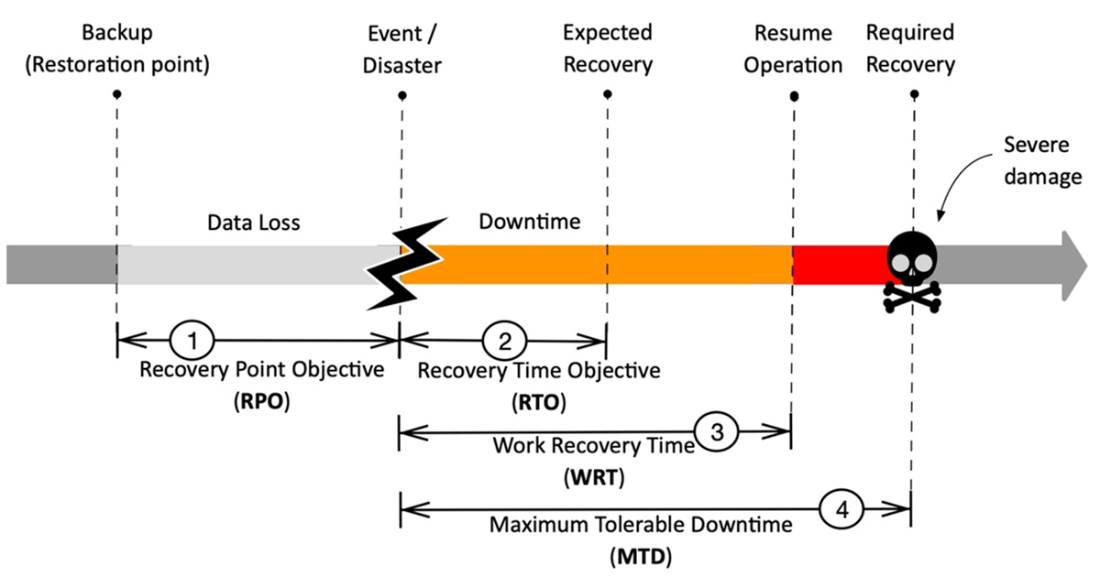
Use the timeline figure to see how RPO, RTO, WRT, and MTD relate during restoration and return to normal operations. section 6.2
BIA results guide the business continuity plan (BCP), which assigns recovery strategies, procedures, roles, and communications for sustaining or restoring critical operations. Plans should be tested, reviewed, and updated. section 6.5 section 6.6

