Buy-in is active support and participation from everyone whose cooperation is needed to carry out a decision. Without it, resistance may appear as delay, repeated questioning, inaction, sarcasm, or gossip. section 9.2.2
Make the decision’s level of participation explicit. An idea invites broad influence; a suggestion states an intention while welcoming insight; a proposal presents a worked-out plan open to serious objections; a command informs people of a decision and their responsibilities. Misrepresenting the level—especially disguising a command—creates frustration and resistance. section 9.2.2
A software design decision
Bring the relevant stakeholders together around a shared model of the proposed solutions. Collaborative modeling makes their perspectives visible and enables evaluation and feedback, but it does not guarantee agreement. If the group chooses a solution that some people opposed, ask: “We’re going with this decision, so what do you need to go along with it?” Add practical support where possible, such as a communication storyline, regular check-ins, or a meeting with architects for clarification. section 9.2.3 section 9.2.3
Figure 9.4 Levels of buy-in plotted on the spectrum of democratic and autocratic decision-making styles
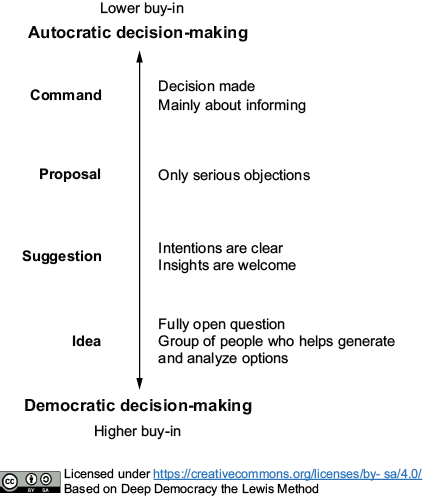
Use the spectrum to compare the four buy-in levels with democratic and autocratic decision-making styles. section 9.2.2

