A cache miss occurs when requested data is absent from the CPU cache and must be retrieved from another memory level. In a game, moving an enemy can wait on its position, direction, and velocity: illustrative access times are 1–2 nanoseconds for L1 cache and 50–150 nanoseconds for main memory. section 1.2.2
Figure 1.7 Simplified example of how the CPU can access data in a system with three cache levels. If the data is not found in L1, the request continues to L2, then L3, and finally main memory. This example shows one possible cache-fill path; the exact behavior depends on the processor.
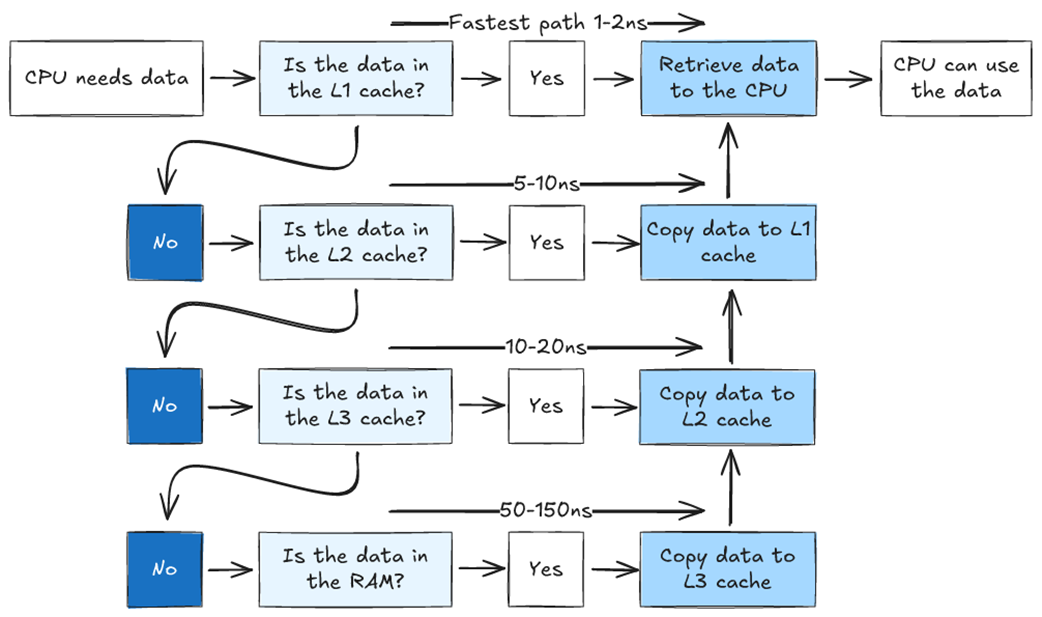
Illustrates one possible path from L1 through L2 and L3 to main memory; the exact behavior depends on the processor. section 1.2.2
To reduce misses, arrange data around what a workload processes together:
- Keep related values close in memory. Because fetching data also brings in nearby data, the next needed values may already be cached. section 1.2.2
- C# arrays of structs occupy a contiguous block, while arrays of classes hold addresses to objects that may be spread across the heap; these layouts differ in data locality. section 2.8