liveBook · Manning

Cache miss ratio

As explained in Designing Deep Learning Systems: A guide for software engineers

The proportion of cache lookup requests whose requested model is not present in the cache.

Cache miss ratio measures the proportion of model lookup requests whose requested model is absent from the model cache. In a multitenant prediction service, it indicates how often model swapping may be required before serving a request. section 6.3.2

Use the metric when managing constrained model-serving resources:

  • Apply least recently used eviction to remove models and make room for requested models. section 6.3.2
  • Partition models across service instances to reduce misses and make model swapping less disruptive. section 6.3.2
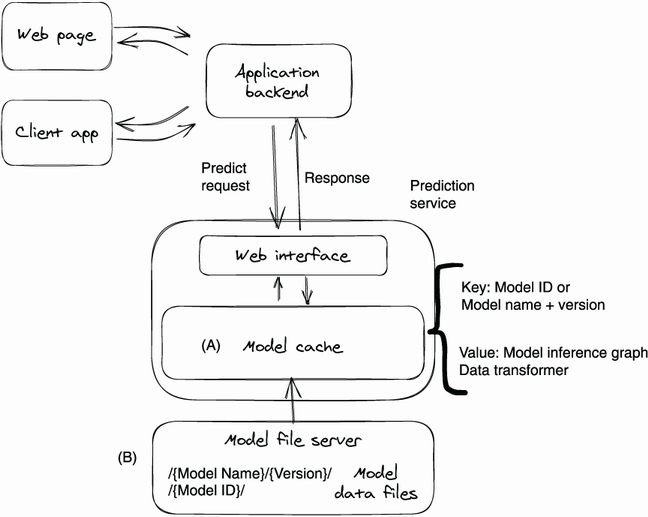
Figure 6.6 A prediction service with model caching for multitenant applications

Use the prediction-service architecture to locate the model cache within a multitenant serving workflow. section 6.3.2


How Designing Deep Learning Systems: A guide for software engineers covers it

How deep it goes
Defines misses operationally and connects them to eviction and model-swapping strategies without detailing metric instrumentation.
Examples
Uses a multitenant prediction service that caches models under limited memory and GPU capacity.
What you can do after
Apply it via LRU eviction and model partitioning when tuning model-cache behavior.
How it connects
Connects cache miss ratio with model cache, model swapping, LRU eviction, and model partitioning.

Also explained in

Compare how 2 books explain cache miss ratio →

Related concepts

This explainer was generated by Manning's knowledge graph from the text of Designing Deep Learning Systems: A guide for software engineers. The section links point to the parts of the book it draws on.