Cache miss ratio is the proportion of cache accesses that fail to find the requested data. Calculate it as misses divided by total accesses, or as 1 minus the cache hit ratio. section 6.2 section 6.5
Interpret the metric operationally:
- A 0% miss ratio means every access is served from the cache; 100% means every access reaches primary storage. section 6.5
- A high miss ratio can make caching ineffective because cache lookup overhead combines with slow backing-store access. section 6.2
- Reduce misses by fitting the working set in the cache and selecting a replacement policy suited to the workload. section 6.5
Working-set pressure
A 10 MB working set placed in a 1 MB cache produces more misses than a cache large enough to hold the working set, increasing backing-store accesses and latency. section 6.5
Figure 6.5 Average cache access latency (y axis) approaches cache hit latency as the cache hit ratio (x axis) increases toward 100%.
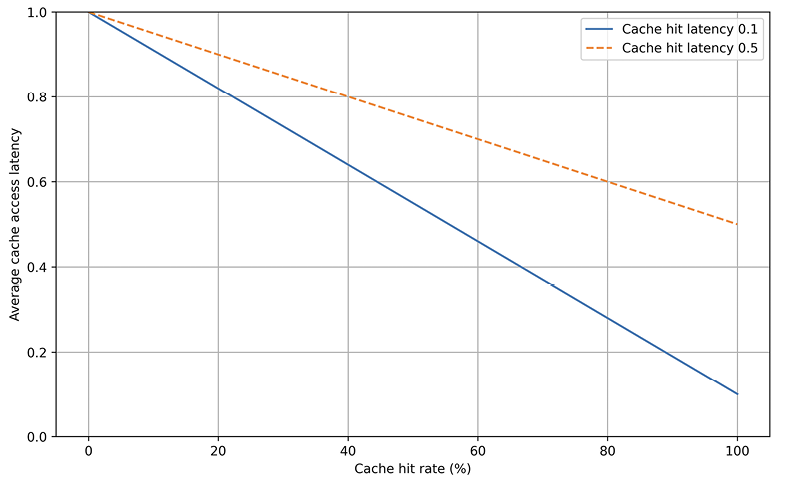
Relate cache miss ratio to average access latency: as the hit ratio approaches 100%, average latency approaches cache-hit latency. section 6.5

